£150 Million Allocated for Asylum Centres as Tories Criticize Labour’s Immigration Policy

The UK government is set to allocate an additional £150 million for the establishment of large-scale asylum accommodation centers on former military properties, as disclosed in the latest budget documents.
This funding is aimed at enabling the Home Office to continue its efforts in closing down controversial asylum hotels that have drawn considerable criticism.
However, the decision raises concerns amongst rural communities, as it may result in a significant influx of asylum seekers, fueling debates similar to those that have emerged regarding existing centers in Wethersfield, Essex, and Crowborough, East Sussex.
Shadow Home Secretary Chris Philp commented, stating that this initiative reflects the government’s lack of intention to halt illegal immigration or facilitate the deportation of individuals. He emphasized the Conservative Party’s strategy, which includes potentially withdrawing from the European Convention on Human Rights to enable the deportation of illegal entrants upon arrival.
According to treasury documents, the £150 million will be earmarked for 2027-28, specifically to fund the development of additional large sites for accommodating asylum seekers, as part of the government’s pledge to terminate the use of asylum hotels.
Details regarding the number or location of new centers have yet to be disclosed. Current accommodation centers have predominantly been set up on former Ministry of Defence bases.
Last month, residents of Piddington, Oxfordshire voted symbolically to disassociate from the UK in protest against plans for a new asylum center expected to significantly outnumber their local population of 350. This new center would house 1,250 adult male asylum seekers.

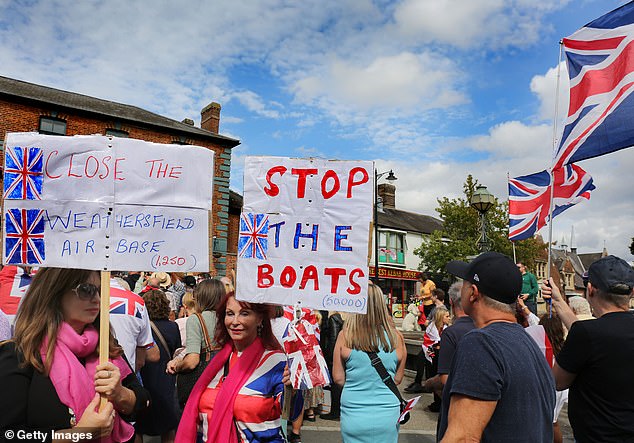
Protesters gather in Braintree, Essex, to demonstrate against asylum seeker accommodation at nearby Wethersfield in August 2025.
Residents have also expressed opposition to additional proposed centers in Barnham and Linton-on-Ouse.
The Wethersfield facility, which cost £49 million to establish, is expected to expand its capacity from 800 to 1,245 beds and now has an adjusted operation timeline extending to 2030.
As of the end of June, there were just over 16,000 asylum seekers accommodated in hotels, a decline from a peak of 56,000 in 2023.

Conservative Party leader Kemi Badenoch visited Piddington in Oxfordshire last month as residents voted overwhelmingly to become an ‘independent state’ in a symbolic protest.
Meanwhile, the Office for Budget Responsibility (OBR) indicated that costs associated with supporting asylum seekers are likely to decrease if the Home Office maintains its current claim processing rate. However, these costs are transferred to local authorities once an individual is granted asylum status.
The OBR also noted that expenditures on homelessness by councils, beyond provisions of the Homelessness Reduction Act, have surged from £2 billion in 2010-11 to £4 billion in 2025-26.
A source within the Home Office clarified that despite the additional funding for new accommodation sites, the overall costs will not necessarily rise, as total asylum spending has declined by £1 billion from its peak period.
Editor’s Take
This decision to invest significantly in new accommodation centers underscores ongoing tensions regarding asylum policies in the UK. By shifting from temporary hotel arrangements to more stable facilities, the government aims to address both logistical and political pressures. As local communities voice their concerns, the effectiveness of these measures will rely on transparent communication and the management of public sentiment.
Source: www.dailymail.com