
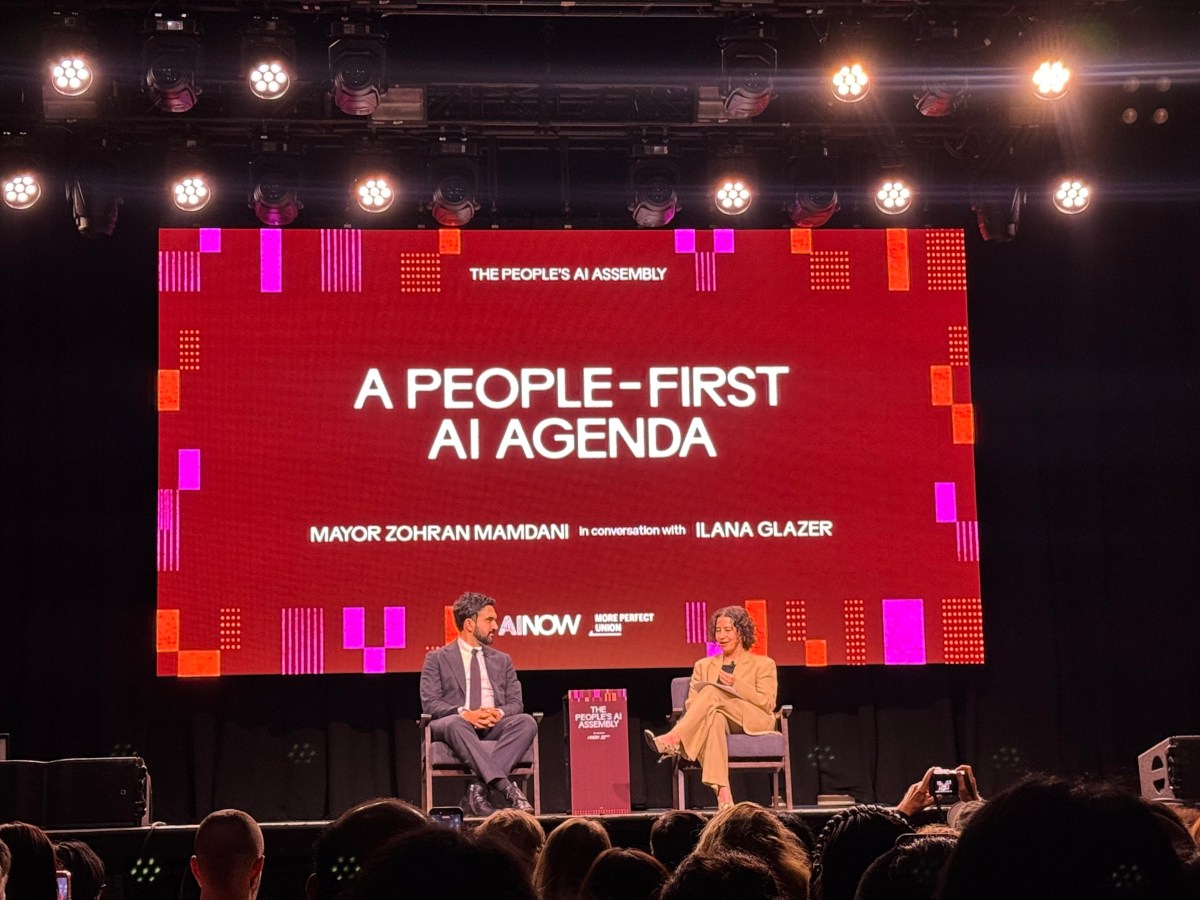

On a recent evening at Webster Hall in Manhattan, two prominent figures, Mayor Zohran Mamdani and acclaimed activist and actress Ilana Glazer, engaged in a thought-provoking discussion about artificial intelligence (AI). Glazer posed critical questions regarding the role of AI in society, prompting Mamdani to challenge prevalent narratives.
Mamdani encouraged New Yorkers to combat the pervasive anxiety that AI will inevitably disrupt their livelihoods and educational systems. Instead, he urged citizens to reclaim autonomy over how the technology is integrated into their lives.
His remarks come at a critical time when federal oversight of AI remains limited, leaving local governments to navigate this complex landscape. Speaking at The People’s AI Assembly, hosted by the AI Now Institute, a research organization focused on AI’s societal impacts, Mayor Mamdani highlighted the need for accountability from AI companies rather than acceptance of their unchecked advancement.
Recently, Mamdani implemented a ban on AI in elementary and middle schools. As a parent, Glazer expressed her apprehensions about the introduction of AI in classrooms, describing the experience as unsettling.
“It just makes me nervous. It feels so non-consensual, as though… this has to be in schools. It wasn’t two years ago. Why does it have to be in schools?” Glazer remarked.
Over the summer, Mamdani also proposed a regulation requiring real estate professionals to clearly indicate when property listings feature AI-generated visuals. This initiative aims to protect residents from misleading listings, a concern echoed by many in the real estate market.
Both initiatives challenge the assumption that technology must be unquestioningly embraced as it emerges in society.
“Nothing has to be,” Mamdani stated at the event. “There’s a creep that comes with this, and an intention to overwhelm that leaves people feeling as though there are limited options.”
He voiced concerns over what he called a “reckless adoption of technology,” citing a catastrophic instance where AI played a role in a U.S. military strike in Iran that resulted in the deaths of over 150 individuals, including many children. This incident has drawn attention to the issues arising from unregulated AI use.
Mamdani highlighted the misguided belief that AI is infallible, questioning why the only voices in the regulatory conversation are those of the technology’s creators. “What it really is,” he suggested, “is an attempt to escape any accountability at any level.”
With significant players like Anthropic set to enter public markets and OpenAI planning an IPO soon, Mamdani criticized the federal government for its “complete abdication of responsibility” in AI regulation.
He pointed out that much of the national dialogue on AI is often framed through a competitive lens with countries like China, sidelining crucial humanistic concerns. The recently announced Superintelligence Task Force, focused on self-regulation among AI corporations, reflects this approach, raising alarms as public apprehensions regarding AI’s impact on society remain high.
“As we contemplate the future of AI beyond this administration, we must develop a different framework for discussing and regulating AI,” Mamdani emphasized.
Editor’s Take
This discussion marks a pivotal moment in the ongoing discourse surrounding AI regulation. Mayor Mamdani’s proactive approach emphasizes the necessity for accountability in AI’s deployment, suggesting that users and citizens should have a voice in this evolving landscape. As AI continues to permeate various sectors, the balance between innovation and safety becomes increasingly crucial for individuals and businesses alike.
Source: techcrunch.com