

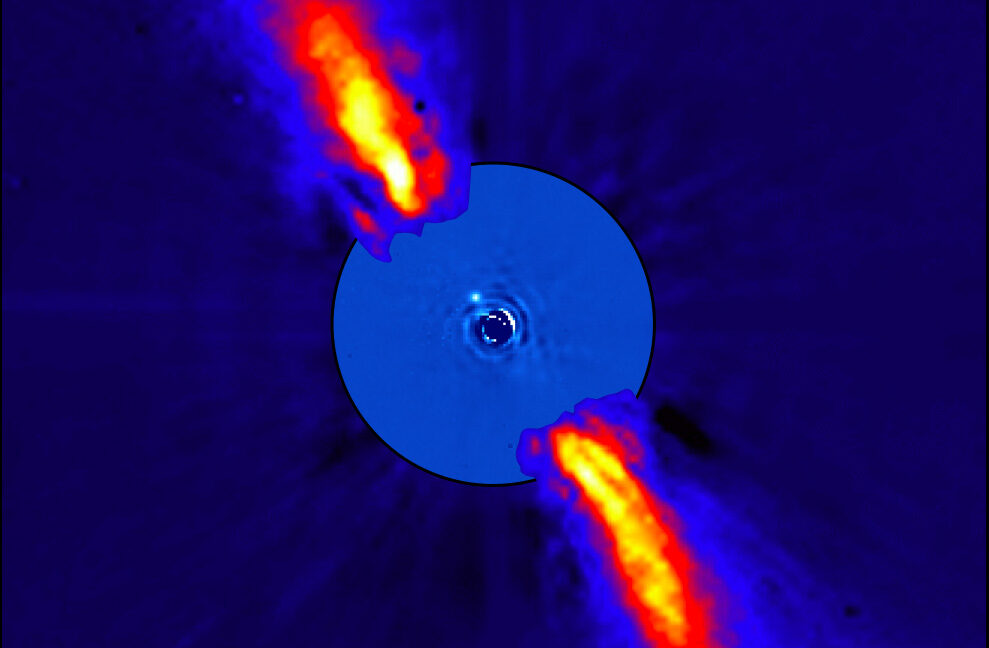

Recent investigations into the distant planetary system of Beta Pictoris have unveiled surprising insights regarding the composition of its water ice. Utilizing advanced observational tools, scientists have discovered that the water ice present in this system is predominantly amorphous rather than crystalline, defying previous expectations that suggested a predominance of crystalline structures in debris disks.
When water freezes under moderate temperatures, it generally forms a crystalline lattice, producing a distinct peak in spectroscopic data just above 3 micrometers. However, this characteristic peak was absent in observations from Beta Pictoris. Instead, researchers found that the majority of the water ice exists in an amorphous state, resembling a glass-like solid created when water molecules freeze rapidly at low temperatures. The team’s analysis revealed that less than 7% of the ice is crystalline, a finding that challenges existing models of ice distribution in such systems.
Understanding the Ice Distribution
For amorphous ice to retain its structure, it typically needs to remain below approximately 100 Kelvin (or minus 173° Celsius). If temperatures rise, external factors such as high-energy ultraviolet light, cosmic rays, or particles from the star would typically disrupt its structure. Researchers surmise that this ice likely formed in the interstellar medium before the planets of Beta Pictoris took shape, raising questions about the processes involved in ice distribution across the disk.
The Role of Collisions
The key to understanding the uniform distribution of ice lies in the concept of continual collisions among planetesimals. Each collision can release icy dust, including previously protected ice from deep inside these colliding bodies, thereby replenishing the ice lost to starlight. Supporting evidence for such collision events has already been documented, with earlier infrared images capturing a distinctive curved streak of dust in the disk’s southwestern arm, indicative of a significant collision.
The findings from the team led by Betti further support the notion that the carbon monoxide gas observed in the disk likely originates from these colliding icy bodies. This work also proposes a viable mechanism through which ice can survive in an environment exposed to ongoing ultraviolet radiation. However, the researchers noted that further investigation is required to ascertain the precise amount of crystalline ice present and to explore the potential for other molecules within the icy mixture.
Interestingly, if the young planetary system, located 64 light-years away, shares similar icy building blocks with our own Solar System, it suggests that primordial interstellar ice may be a common feature in the formation of planetary systems. This revelation has significant implications regarding the potential for water-rich and possibly habitable worlds elsewhere in the universe.
Science, 2026. DOI: 10.1126/science.adw7770
Editor’s Take
The discovery of predominantly amorphous ice in the Beta Pictoris system reshapes our understanding of planetary formation and the building blocks of celestial bodies. As researchers delve deeper into the properties of interstellar ice, this could inform models of habitability across the galaxy, unlocking potential opportunities for future explorations and technologies aimed at seeking life beyond Earth.
Source: arstechnica.com