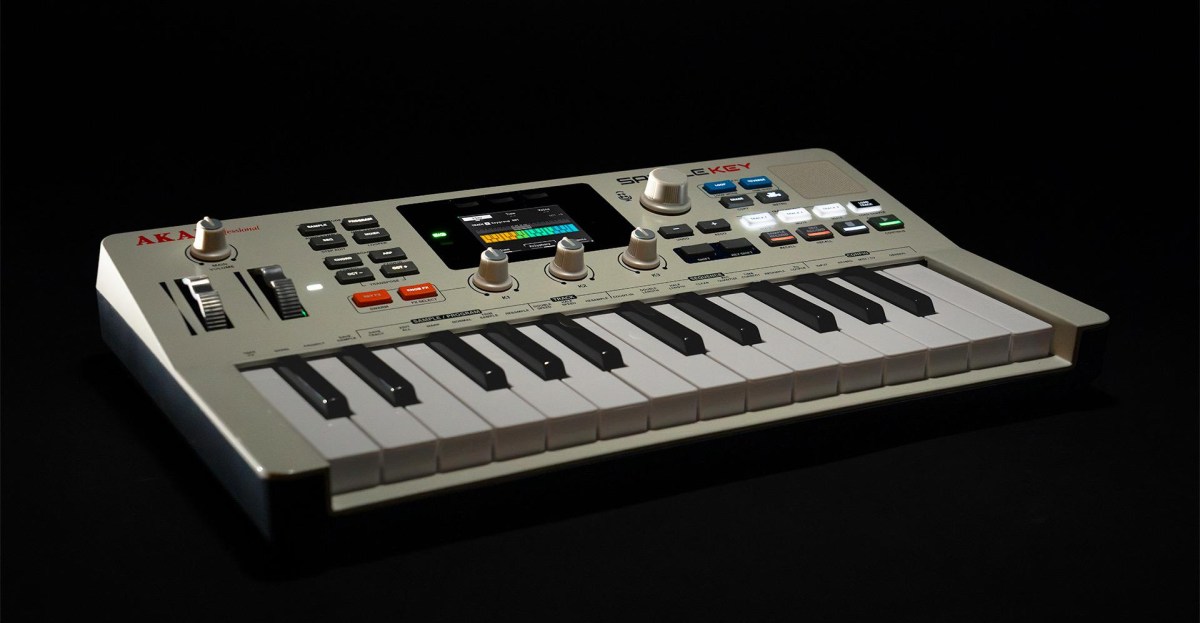

Akai has recently teased its innovative MPC Sample Key on Instagram, revealing plans to make its software open-source. This move aims to encourage the modding community to explore and expand the device’s capabilities. While the exact launch date and price remain under wraps, The Verge has obtained exclusive images that shed light on its features.
The MPC Sample Key retains several controls from the original MPC Sample, such as three context-sensitive encoders and a prominent main encoder. However, it is primarily engineered for pitched sample playback, distinguishing it from its predecessor, which was designed for drum sampling. Notably, the familiar “chop” button is absent from this new device.
Additional clues to its intended use include dedicated pitch and modulation wheels. Users will also find buttons designed to change the octave range on the 25-key keyboard, along with features labeled “chord” and “arp.” This suggests functionality for chord playback and arpeggiation, which, while innovative for melodic compositions, may not be as beneficial for drum sampling.
Another intriguing addition is a dedicated looper, likely aimed at enhancing live performances and facilitating sound layering. Instead of the Flex Beat effects featured in the original, the new model introduces something called “Swarm,” though further details about this feature are yet to be clarified.
Similar to its predecessor, the MPC Sample Key includes a built-in microphone and speaker, enabling a self-contained music production experience. Although the back panel configurations remain unseen, front-panel options suggest compatibility with MIDI and CV outputs, allowing for integration with modular synthesizers.
Correction October 30th: The MPC Sample Key consists of 25 keys, not 37.
Editor’s Take
The introduction of the MPC Sample Key marks an important evolution in music production tools, especially with its open-source promise. This could significantly empower users and developers alike to customize their experience, fostering creativity within the music modding community. Such enhancements not only diversify the product’s appeal but could also reshape workflow for musicians, making tools more malleable and tailored to personal artistry.
Source: www.theverge.com