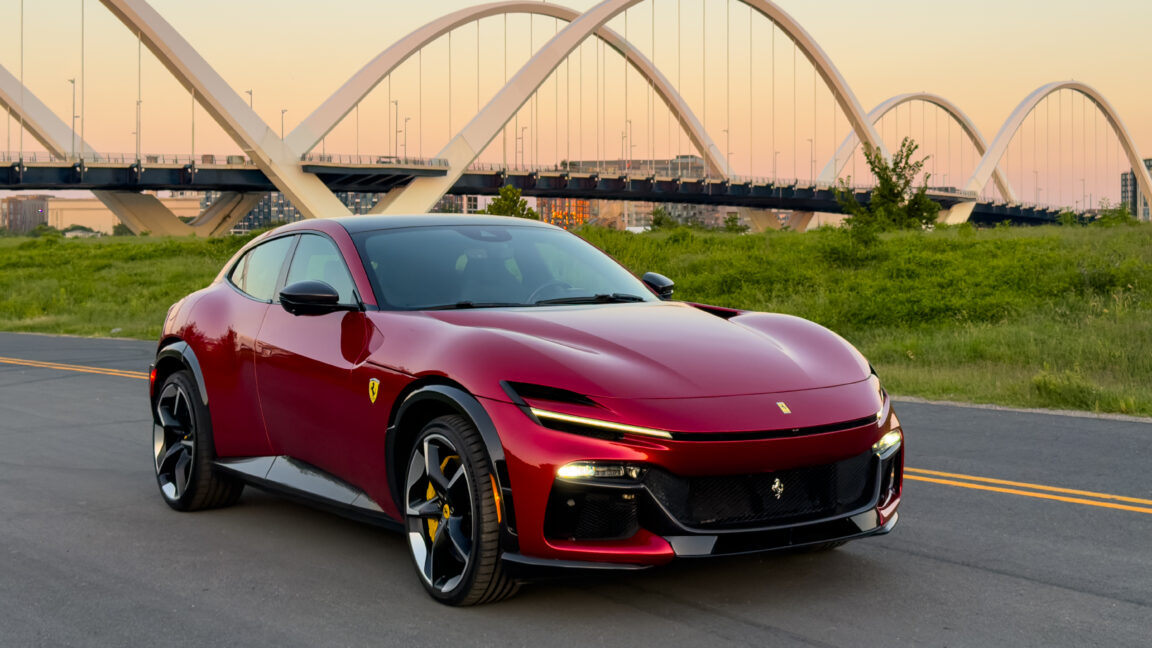

The Evolution of the Ferrari Experience: Introducing the Purosangue
Ferrari, renowned for its iconic two-seat sports cars, has long recognized the desires of customers seeking more spacious vehicles for passenger transport. The brand’s foray into cars with back seats began in the 1960s with the release of the 250 GT 2+2. As suggested by its name, the rear seating was limited to occasional use, a trend that persisted until the early 2000s with models like the 612 Scaglietti.
Progressing through the years, Ferrari debuted its first true four-seater with the FF, characterized by all-wheel drive and a distinctive “Breadvan” aesthetic. Although this marked a shift towards practical family vehicles, it still remained a three-door design, prioritizing cargo space over passenger comfort. The subsequent model, the GTC4Lusso, followed suit. However, the advent of the Purosangue signifies a noteworthy upgrade in passenger accommodations.
The Purosangue features an additional set of rear-hinged doors that provide direct access to its rear bucket seats. Alongside a rear hatch, this brings the total door count to five. However, a solid firewall separates the cargo area from the passenger section, and the rear seats are not designed to fold flat. Consequently, while running errands may be feasible, users planning outdoor adventures requiring bulky items might find the need for extra storage solutions, such as a roof rack. Interestingly, Ferrari distinguishes the Purosangue as an “FUV” or Ferrari Utility Vehicle, rather than an SUV.
At the heart of this vehicle is a formidable 6.5-liter naturally aspirated V12 engine, positioned toward the rear of the chassis, classifying it as a front-mid engine layout. This engineering choice supports a 49:51 front-to-rear weight distribution. Enhancing performance further, the vehicle employs an eight-speed dual-clutch transaxle gearbox, directing power to the rear wheels, while a separate unit at the front manages the front wheels, ensuring it remains an all-wheel-drive machine. The specifications speak volumes of its capabilities: a robust 715 horsepower (533 kW) and 528 lb-ft (716 Nm) of torque housed in a car measuring 195.8 inches (4,973 mm) in length, 79.8 inches (2,028 mm) in width, 62.6 inches (1,589 mm) in height, with a wheelbase of 118.1 inches (3,018 mm) and a curb weight of 4,784 lbs (2,170 kg).
Editor’s Take
The introduction of the Ferrari Purosangue represents a significant milestone in the brand’s evolution, effectively blending luxury with practicality. This move not only caters to a growing market for high-performance vehicles that accommodate families but also redefines what consumers can expect from the Ferrari experience. As the automotive landscape continues to shift, the Purosangue could pave the way for further innovation in vehicle design and performance.
Source: arstechnica.com