
Rethinking the Origins of Bantu Languages and Cultures
By the 1990s, some academic circles began to challenge the prevailing narrative that Bantu languages and skills spread primarily through migration. Instead, they proposed that these cultural traits could have been exchanged among local hunter-gatherer communities without significant movement. This theory posited that innovations in technology, language, and social habits could have circulated in a more stationary context.
Advances in genetic analysis techniques, capable of tracing people’s ancestry, have greatly contributed to this ongoing debate. Humans share varying degrees of DNA with their relatives—approximately 50% with siblings, 12.5% with cousins, and merely 3.3% with second cousins. Though these genetic proportions shrink as one goes further back in time, statistical methods can uncover significant patterns within genetic data.
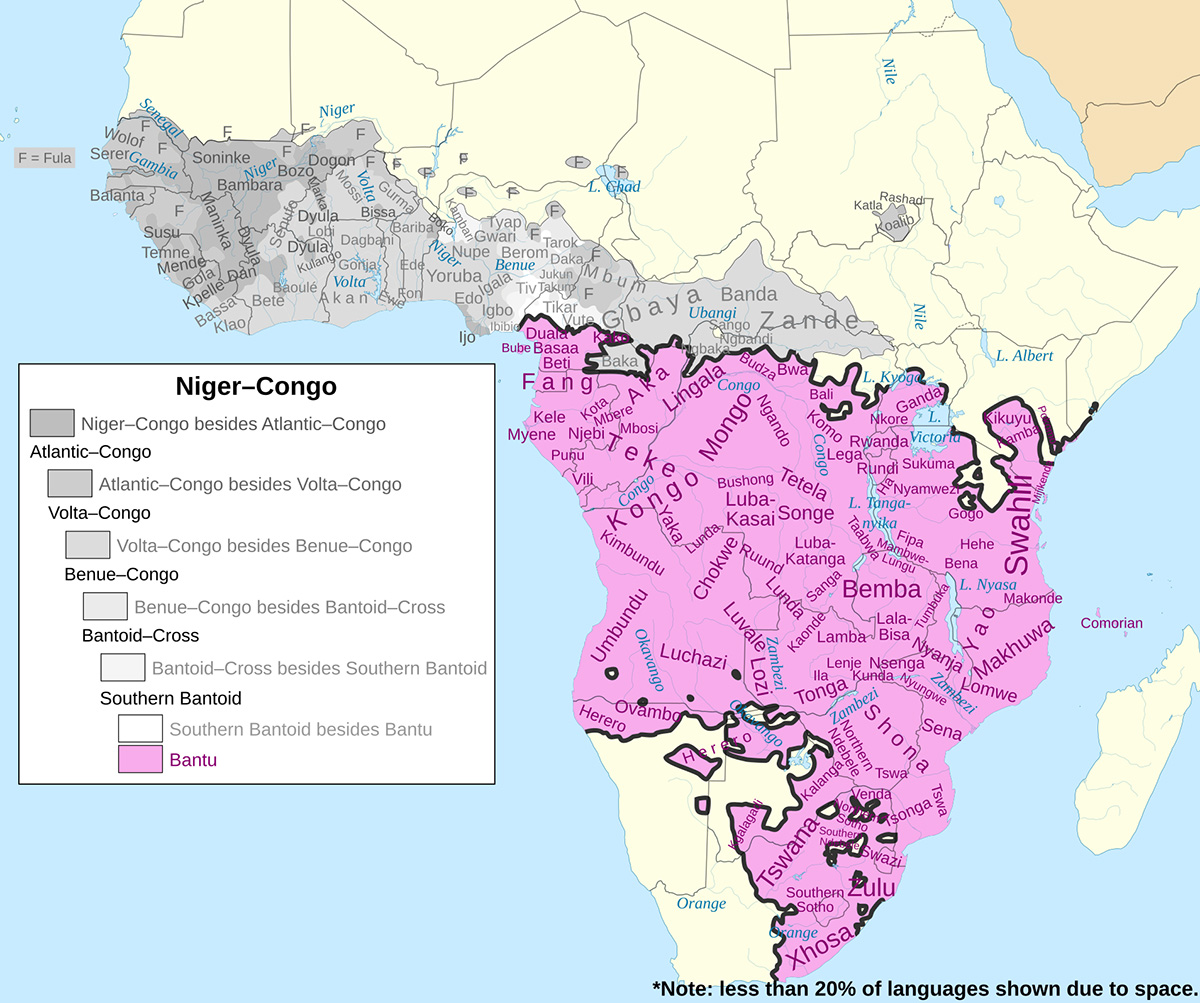
A notable 2009 study involving a genetic analysis of 2,432 individuals across Africa revealed surprising genetic links among Bantu-speaking populations from western, central, and southern Africa. This interrelatedness was more pronounced than geographical distances would suggest. In a more recent 2024 study, researchers examined the genomes of 1,763 Africans, finding that Bantu speakers in western Africa exhibited the highest genetic diversity. Interestingly, genetic diversity diminished with increasing distance from this focal area. According to Carina Schlebusch, a geneticist at Uppsala University, this pattern points to a classic sign of a population expanding outwards from a centralized location.
Credit: Wikimedia Commons
Uncovering the Bantu Roots
While linguistic and genetic evidence points towards western Africa—specifically the Grassfields region of Cameroon—as the ancestral homeland of the Bantu, archaeological corroboration remains scant. At Shum Laka, the most extensively researched archaeological site in the Grassfields, pottery shards have been dated from between 7,000 to 6,000 years ago, becoming more abundant around 5,000 to 4,000 years ago. The early bowls and jars, initially marked only with incised patterns, later showcased more complex designs, potentially hinting at the cultural practices of Bantu ancestors.
Further south, in the Congo rainforest, archaeologists have been actively searching for evidence of the earliest Bantu settlements. Between 2010 and 2023, Alexandre Livingstone Smith from Belgium’s Royal Museum for Central Africa conducted expeditions along the Congo River. Working alongside linguist Birgit Ricquier, Smith uncovered pottery fragments from several villages that share stylistic similarities with those found in western Africa, dating back to 2,300 to 2,000 years ago. These findings may indicate the migrations of the first Bantu settlers into the forested region.
Editor’s Take
This research sheds light on how cultural and genetic exchanges have shaped societies across Africa. Understanding these migrations is not just an academic pursuit; it has implications for identity and cultural heritage in contemporary African nations. For businesses and developers working in tech, this knowledge could inform community engagement strategies, particularly in language and education technologies.
Source: arstechnica.com