

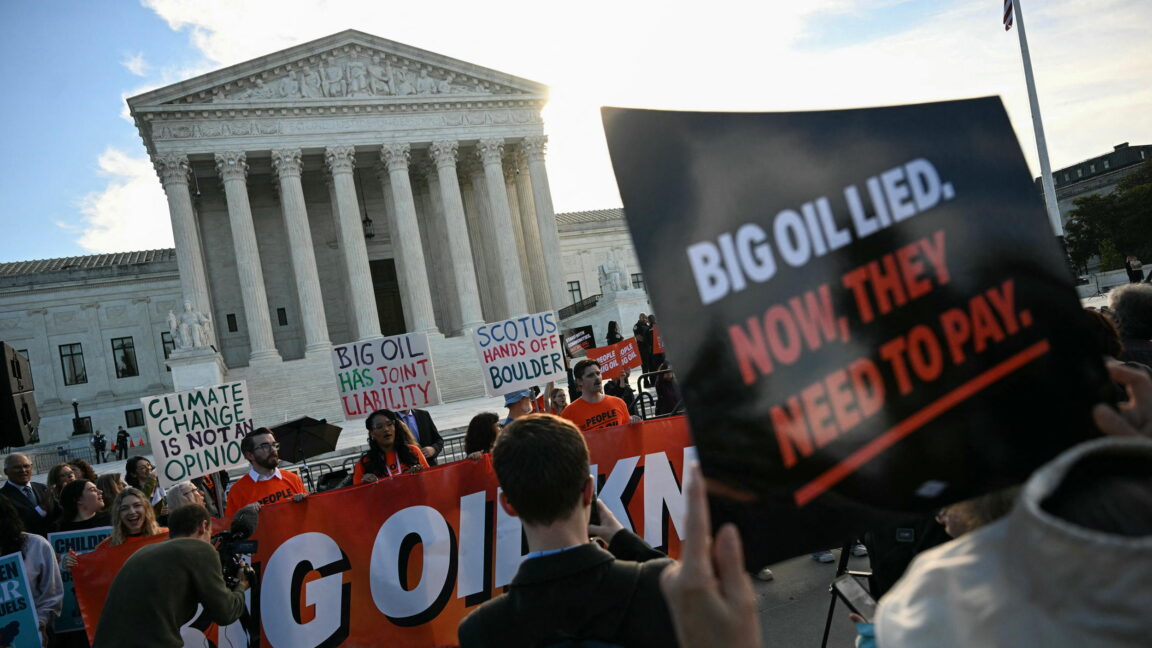

The Supreme Court Weighs Critical Climate Case Against Oil Companies
During a recent hearing, attorney Russell contended that the city of Boulder‘s legal action does not aim to directly limit pollution. He emphasized that neither the Clean Air Act nor the U.S. Constitution prohibits states from implementing measures that may incidentally lead to reduced pollution, such as imposing a tax on gas or seeking financial damages from oil corporations.
Notably absent from the proceedings was Justice Samuel Alito, who recused himself ahead of the hearing without providing a reason. Alito’s recusal came amid scrutiny due to his financial ties to oil companies involved in related litigation, raising questions about potential bias in the case.
His absence leaves the possibility of a tie vote, which could allow the case to advance. Outside the court, supporters rallied in favor of Boulder’s position, urging the justices to let the case proceed.
“Every day, cities like Boulder confront the stark realities of climate change,” remarked Nuria Rivera-Vandermyde, Boulder’s city manager, following the hearing. “The central question is whether taxpayers should shoulder these burdens alone or if the parties responsible for the damage owe a fair share to the community.”
The case has garnered backing not only from environmental advocacy groups and Democrats but also from a range of academics and former officials from the Environmental Protection Agency, including appointees from Republican administrations. This broad coalition highlights the growing consensus on the urgent need to address climate-related damages.
On the opposing side, numerous conservative organizations and politicians have submitted briefs in support of the oil firms. The previous administration led by Donald Trump also made arguments before the justices.
Numerous legal actions initiated by various states and local governments are currently on hold, awaiting the outcome of the Supreme Court’s ruling in the Boulder case. A decision is anticipated by the end of the court’s term in June, which could either halt these claims abruptly or pave the way for further trials.
Nicholas Kusnetz is a reporter for Inside Climate News. He has previously contributed to the Center for Public Integrity and ProPublica, earning accolades from various journalism organizations. His work has appeared in publications like Wired and The Washington Post.
This story initially appeared on Inside Climate News.
Editor’s Take
The Supreme Court’s decision in this pivotal climate case could reshape the landscape of environmental accountability in the U.S. It reflects a growing acknowledgment of the impacts of climate change and places pressure on major corporations to take responsibility for their contributions to this crisis. Depending on the ruling, businesses and local governments may need to reassess their strategies surrounding environmental policy and financial liability.
Source: arstechnica.com