
Australian politicians and business leaders are increasingly concerned about a growing wave of public skepticism surrounding the establishment of AI datacentres. They argue that this sentiment is largely influenced by trends stemming from the United States.
Similar to the situation in the US, Australia is witnessing rising community discontent regarding the rapid expansion of massive AI datacentres. However, proponents of these developments assert that Australia’s efforts are significantly smaller in scale, better regulated, and therefore pose less of a threat compared to the US. They contend that the intensifying backlash in Australia has been exacerbated by heated discussions online that have crossed over from the US.
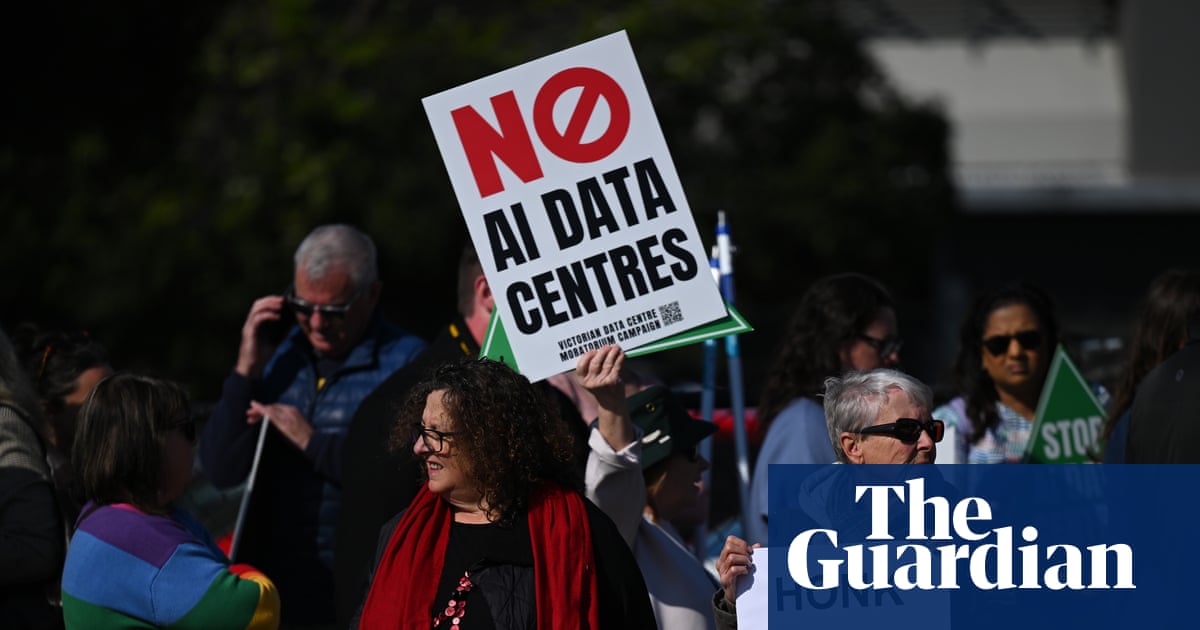
The backlash that began in the US last year has gradually resonated in Australia and has now escalated into national discourse by 2026. This has resulted in calls for a moratorium on new datacentre developments, community protests, multiple government inquiries, and the crafting of state frameworks. The Australian government is actively working to establish regulations governing the construction and operation of datacentres, focusing particularly on their energy and water consumption.
State governments, eager for economic growth, have generally welcomed investments in these new facilities. In some instances, they have circumvented local council approvals, considering the magnitude of the projects. In July, the then-minister for economic growth in Victoria, Steve Dimopoulos, highlighted that Victoria ranked second to New South Wales in terms of datacentre presence, and boasted faster growth in new constructions. He expressed concern that the increasing public discontent was predominantly a byproduct of US social media influence.
Minister Dimopoulos noted, “We’re witnessing some US states moving to ban large datacentres. These developments shape public sentiment here in Australia. When it appears on your phone, it feels incredibly close.”
He emphasized, “We are not the United States. Our systems for planning, energy, and water management are much more carefully observed and regulated.” Leaders in the datacentre sector have also voiced their discontent with the backlash, describing it as misleading.
Belinda Dennett, head of Data Centres Australia, highlighted this sentiment during a March speech, stating that the discussion surrounding datacentres in Australia is being overshadowed by American concerns. “The industry is portrayed as energy vampires, water hogs, and job destroyers,” she remarked, stressing that most of these claims stem from conditions in the US that are not directly applicable to the Australian context.
Dennett pointed out that the US has approximately 5,400 datacentres with a total capacity of 53.7 gigawatts, while Australia only has 252 datacentres with 1.4 gigawatts. She argued that when Australians read about the US challenges related to energy strain, rising costs, and excessive water use, they do so without adequately considering the differences in market conditions.
The pace of datacentre construction in Australia is rapidly increasing, with several large facilities in the planning stages, each with capacities exceeding 1 gigawatt. Notably, a proposed 2.4 gigawatt centre in outer Melbourne and a 2 gigawatt gas-powered centre in the Northern Territory have sparked significant local concern.
Rob Nicholls, a professor at the University of Sydney, indicated that the energy demand from such centres could equate to the annual electricity consumption of 2 million households, drawing parallels to the issue in the US, where gas booms driven by datacentre energy demands have become contentious.
To address rising concerns, the Australian government is moving to impose regulations that would necessitate datacentre operators to inject equal amounts of new renewable energy into the grid for their energy consumption. This follows a widespread acknowledgment that the backlash against datacentres is rational, given the implications for electricity and water costs.
Legislative developments surrounding datacentre operations are anticipated no sooner than next year. Meanwhile, there are currently several inquiries—two at the state level and one federally—into the ongoing surge in datacentre developments.
Many of Australia’s datacentres are owned by US corporations, leading to skepticism among Australians. Assistant Minister for Technology Andrew Charlton pointed out that simply constructing datacentres does not guarantee that Australia will benefit economically. He urged datacentre providers to offer access to their computing resources to local startups, researchers, and non-profit organizations under favorable terms, emphasizing the need for Australia to nurture its own AI capabilities.
“We risk becoming reliant on imported intelligence,” Charlton warned.
Editor’s Take
This evolving situation regarding AI datacentres in Australia underscores the balancing act between fostering technological growth and addressing community concerns. The response from state governments and business leaders indicates a proactive approach, yet the necessity for thorough regulations remains imperative. As discussions continue, the implications for users and the broader tech industry will be significant, necessitating careful navigation to ensure both advancement and local acceptance.
Source: www.theguardian.com