

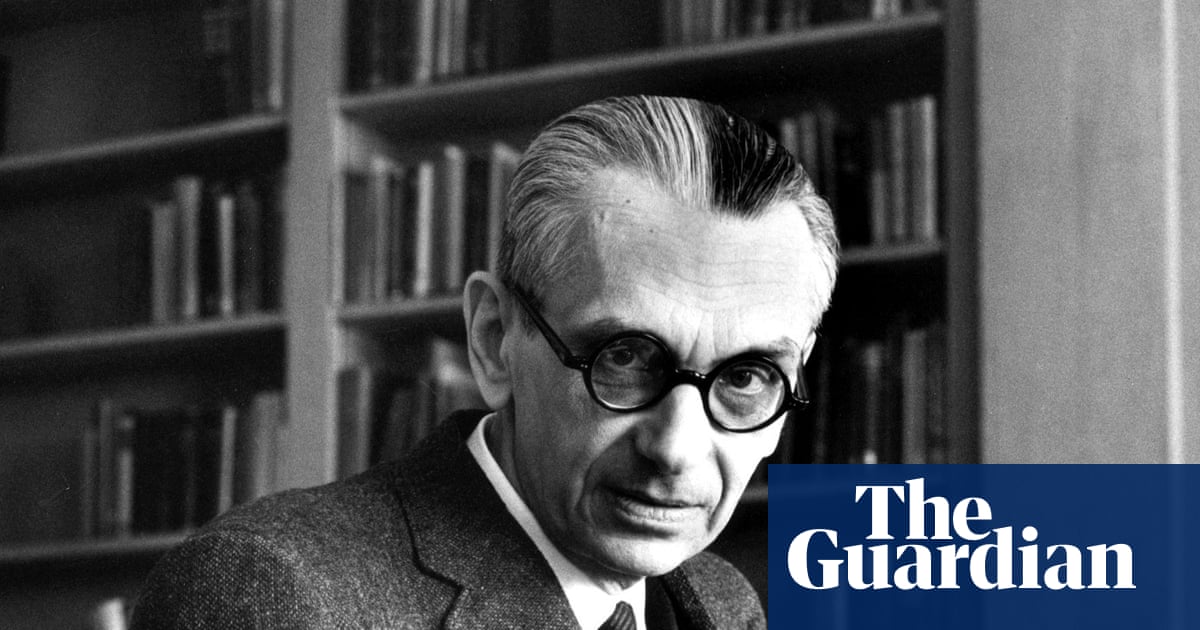

The renowned Austrian logician Kurt Gödel was a pivotal mind of the 20th century. His groundbreaking incompleteness theorems from 1931 not only reshaped mathematics but also laid the groundwork for advancements in the digital era.
Despite his significant contributions during the 1930s, Gödel published limited papers afterward. However, his unpublished writings, which span tens of thousands of pages, have garnered substantial interest from historians of science.
Since 2017, Finnish logician Jan von Plato has spearheaded an initiative at Helsinki University aimed at deciphering 16 notebooks Gödel wrote in the early 1940s. This collection, referred to as the “workbooks,” comprises 1,009 pages filled with intricate text on mathematics and logic, much of which is in the obsolete German shorthand known as Gabelsberger.
Initially, the process of understanding this material was painstakingly slow, with progress averaging just one page per week. However, a breakthrough occurred in September when von Plato sought the assistance of the AI model Claude. Within days, Claude produced a detailed summary of the workbooks, revealing that Gödel had established numerous theorems previously unknown.
This discovery indicates that the eminent logician had made more contributions than previously appreciated.
“I was flabbergasted,” remarked von Plato. “The workbooks not only include numerous anticipations of results that emerged in the 1970s and 1980s, but also encompass 14 unexplored themes in logic. Gödel was undeniably ahead of his time.”
Gödel’s influence on logic is monumental; his incompleteness theorems unveiled the inherent limitations of mathematical knowledge. These theorems assert that within any mathematical system, there exist true statements that cannot be conclusively proved or disproved. While this revelation was disheartening for earlier generations of mathematicians, it spurred new avenues of inquiry and inspired figures such as Alan Turing, who wrote a seminal paper on computation theory in 1936.
In 1940, Gödel escaped from Austria due to the Nazi regime and eventually settled in Princeton, New Jersey, where he became a close acquaintance of Albert Einstein at the Institute for Advanced Study. In his later years, marked by increasing paranoia, he developed a refusal to consume food unless prepared by his wife, ultimately leading to his death from starvation in 1978.
Von Plato initiated his project in 2017 as he faced compulsory retirement from his position at the university. “What could I do to ensure my relevance? I thought, I’ll start reading Gödel’s enigmatic shorthand!” With a grant of €2.5 million from the European Research Council, he taught himself Gabelsberger shorthand, becoming one of only six people globally capable of reading it, and built a small research team.
During a conference in France in August, von Plato encountered computer scientists who encouraged him to employ Claude’s capabilities to interpret the workbooks. Upon returning to Helsinki, he transcribed the notebooks and paired them with six supplementary books he had previously authored on Gödel and related scientific literature.
“Within days, I received a 650-page analysis of the workbooks,” von Plato explained. “While each page required careful verification, this was a task infeasible for any human. We are limited to digesting one page at a time and often forget elements between readings, making it take a year to consume merely 50 pages.”
The AI, he noted, can integrate all of Gödel’s works into a cohesive whole.
The implications of Gödel’s incompleteness theorems are profound, introducing the existence of statements whose truths remain independent of the systems in which they appear—meaning these statements cannot be proved or disproved from within their respective frameworks. In 1966, Paul Cohen, an American mathematician, was awarded the Fields Medal for demonstrating the independence of notable mathematical propositions: the continuum hypothesis and the axiom of choice.
Gödel responded to Cohen’s award by claiming that he had already established the result in the 1940s, yet he could not recreate a proof when pressed by peers.
This prompted von Plato to instruct Claude to determine if Gödel’s workbooks contained a proof of the independence of the axiom of choice, thereby validating Gödel’s assertion from 1966. The feedback was promising: “Yes, nearly,” said von Plato. “Gödel was only one step away; he had a flawed definition but had proposed the correct one two years earlier. Had he continued his work for another few months, I believe he would have reached the accurate definition.”
Von Plato expressed admiration for Gödel’s proof architecture, citing it as a harmonious representation of results from set theory.
Upon receiving Claude’s reconstruction of Gödel’s proof of independence, von Plato utilized a proof assistant named Coq, which verifies the validity of mathematical proofs, and it passed successfully. He contended that had Gödel published his deductions regarding the axiom of choice, he would likely have claimed the Fields Medal in 1940. “Perhaps he felt that Cohen receiving the medal was something he had missed out on.”
In continued investigations with Claude, von Plato tasked the AI to extract all theorems from the workbooks for which Gödel either had a proof, outlined a proof, or theorized a proof. Claude identified 663 theorems. When these findings were checked using Coq, approximately 400 were confirmed as stated, around 200 required adjustments, and about 50 were deemed incorrect—something Gödel himself acknowledged in his notes with comments such as falsch! [false] or schlecht! [bad].
Looking ahead, von Plato believes that continued examination of Gödel’s manuscripts will unveil more significant discoveries. The workbooks reportedly encompass over a dozen themes in logic and the foundations of mathematics that have remained unexplored since their creation. Additionally, Gödel’s notebooks on physics and cosmology represent a largely uncharted area that von Plato plans to investigate after completing his current projects.
Joel David Hamkins, a logic professor at the University of Notre Dame, Indiana, has not reviewed the reconstruction of Gödel’s proof but stated that if it holds up, it would be both remarkable and of historical significance. However, he noted that it remains to be seen how much of the work is attributable to Claude versus Gödel himself, thus emphasizing the importance of historical context in evaluating these findings.
Hamkins concluded, “Just because elements resemble Cohen’s proof does not equate to Gödel having it; it indicates he was on the right path. One cannot receive credit for untold work, but given Gödel’s groundbreaking contributions, it’s perhaps unsurprising that his notebooks teem with intriguing insights.”
Editor’s Take
This development highlights the powerful intersection of AI and historical research, revealing long-lost insights from a giant in logic. It could significantly deepen our understanding of Gödel’s contributions, offering businesses and researchers innovative tools to explore complex works. Enhanced AI analyses may transform how we approach archival research across various disciplines.
Source: www.theguardian.com