
Rika Antonova, who has been immersed in the realm of robotics since 2015, currently serves as an associate professor at the Department of Computer Science and Technology at the University of Cambridge.
Her research centers on creating innovative software and hardware solutions to enable robots to acquire intricate behaviors.
To aid in this endeavor, she utilizes a training system known as MuJoCo, which has been under the ownership of Google’s DeepMind since 2021.
This open-source software allows free access for researchers, along with the flexibility to modify its code.
Describing these tools, Antonova notes, “It is very, very user-friendly. So for research groups or for small start-ups, that’s useful.”
She expresses optimism about Vsim’s fast simulation methods, saying, “If you have a very, very fast simulator, then you can simulate hundreds of millions of samples in the seconds that your robot is thinking about how to adjust its motion, and then you can change the motion almost in real time.”
However, she also points out the limitations inherent in these simulated environments, which remain rough approximations of the real world, constraining the training potential.
“There are certain things that are hard to model in simulation, like highly deformable objects and cutting,” Antonova explains.
This challenge is currently being tackled by teams at Nvidia, as well as Lu and Storey at Vsim.
Lu has remarked that their system employs “reduced approximation, using accurate simulations to train models that genuinely work in reality as well as they do in simulations.”
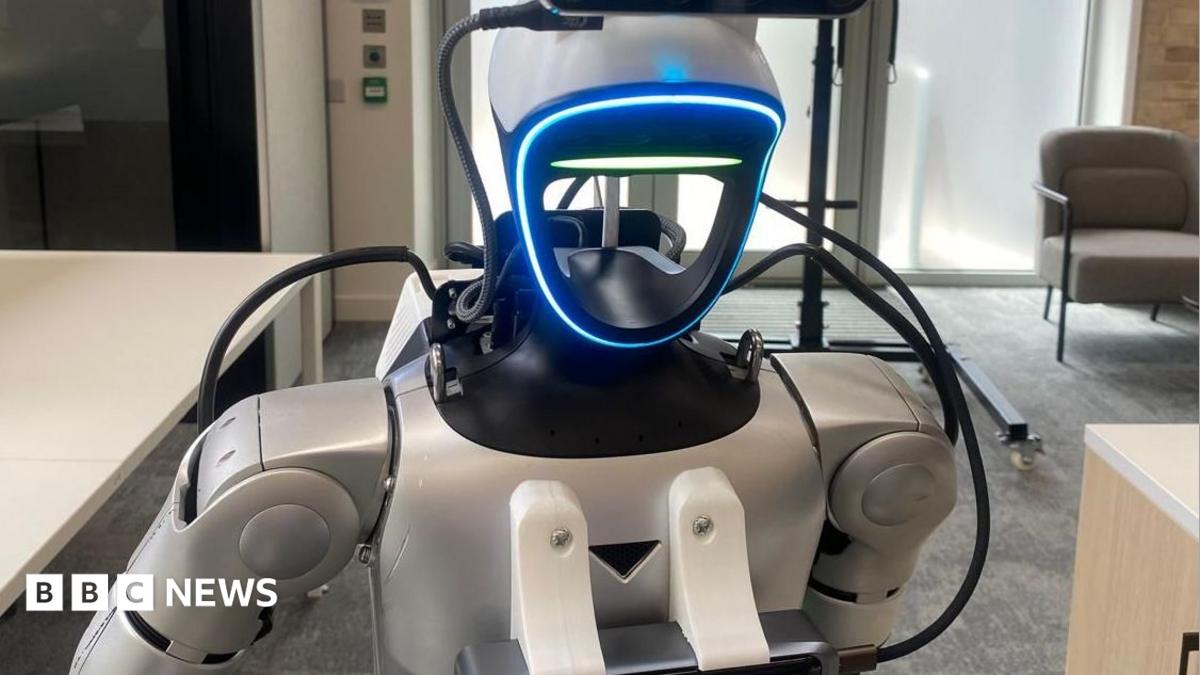
To support this technological advancement, a second robot named Nacho is set to join the development efforts, which Lu believes will expedite their progress and extend software compatibility across various machines.
This addition will also provide some company for their existing robot, Freddo.
Editor’s Take
The advancements being made in robotic simulation technologies highlight a significant leap towards enhancing autonomous systems.
Fast and accurate simulations are crucial for developing real-world applications of robotics, especially in complex environments.
As these technologies evolve, we could see accelerated innovation in industries that rely on robotics, influencing everything from manufacturing to personal assistance.
Source: www.bbc.co.uk