

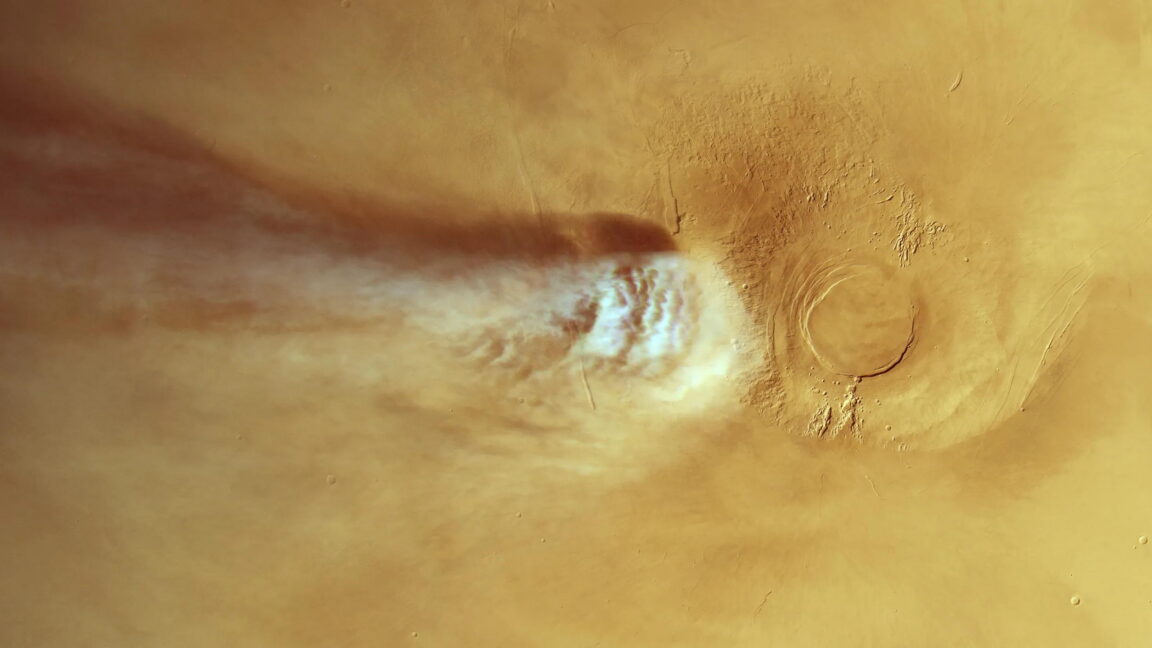

New Research Uncovers Unique Cloud Formation Mechanism on Mars
Recent findings published in Nature Geoscience present a groundbreaking understanding of cloud formation in the Martian atmosphere. This study proposes that the atmospheric phenomena known as Atmospheric Mesoscale Eruptive Clouds (AMEC) could be forming through a process called homogeneous nucleation. Unlike traditional cloud formation processes, which require tiny particles such as dust or salt to serve as nuclei for water vapor to condense upon, homogeneous nucleation allows ice crystals to form spontaneously from vapor.
Lead researcher Hernández-Bernal illustrated this concept with a striking analogy: “It’s akin to droplets of condensation appearing in the middle of a room, rather than on a window.” This revelation is surprising and suggests that the conditions on Mars are far more extreme than previously understood.
The formation of these clouds necessitates severe atmospheric conditions, with temperatures plummeting by 30° Celsius within just 10 minutes, coupled with exceptionally high humidity levels. The towering Arsia Mons volcano plays a pivotal role in this phenomenon. When atmospheric winds interact with the 65,000-foot structure, they generate powerful waves that propel moist air into the higher altitudes rapidly.
While scientists have long theorized that similar processes might occur on other planets, including Venus and Earth, direct observations have been elusive. This is largely due to the extreme humidity required, which exceeds 100,000 times the highest levels measured on Earth.
The findings also challenge prior assumptions about Martian atmospheric conditions, suggesting that such high levels of humidity can exist on the planet. “We don’t have nearly as much information about Mars’ atmosphere as we do about Earth’s, so reproducing AMEC to this extent is a significant achievement,” Hernández-Bernal remarked, expressing excitement at the study’s results.
Editor’s Take
This new insight into cloud formation on Mars opens doors to a deeper understanding of atmospheric science not only on our planet but across the solar system. For researchers, this could enhance models predicting Martian weather patterns. For businesses in space exploration, it underscores the need for advanced atmospheric studies in future missions. Overall, it marks a significant step in unraveling the complexities of Mars, paving the way for potential future explorations.
Source: arstechnica.com