
Tragedy struck in Spain, where at least 64 people have lost their lives, and over 80 others have sustained injuries following a catastrophic collision between two high-speed trains. The incident occurred when an Iryo service traveling from Madrid to Seville halted near Toledo due to a signaling issue.
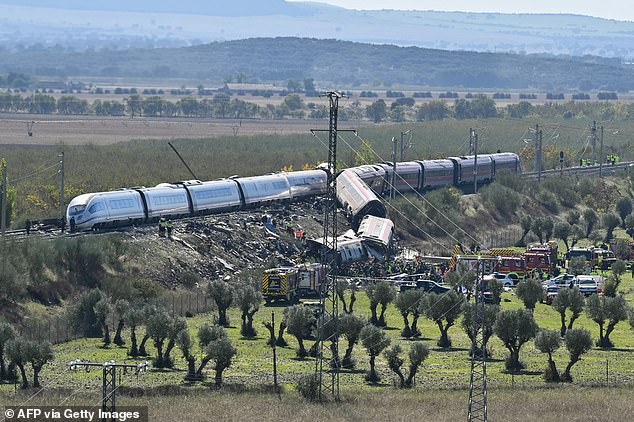
Just ten minutes later, a Renfe train, unaware that the Iryo train was stationary, collided with it. The aftermath was devastating, as several carriages from both trains derailed. Most of the fatalities are believed to have occurred in two train cars that plummeted down an embankment.
Approximately 544 passengers were on board the two trains, which are capable of reaching speeds of up to 300 km/h (roughly 185 mph). Reports suggest that the Iryo service stopped without activating its emergency systems, allowing the Renfe train to crash into it.
One passenger, Sebastián Herrero, recounted the terrifying experience to the Spanish newspaper El Mundo. He described being thrown against the seats during the impact, saying it felt like “a lifetime” as he was airborne for several seconds. Herrero added, “It’s apocalyptic. In those three carriages, I find it very hard to believe that there are any living people. It’s a twisted mass of metal. It’s as if they had planted a bomb.”
Train driver unions have expressed their surprise at the incident, given the circumstances and existing signalling systems. As investigations continue, it remains unclear how fast both trains were traveling when they collided.
The regional government has since updated the death toll to at least 64, a significant rise from the previously reported figure of 31.
Spokesperson for the Castilla La Mancha region, Esther Padilla, warned that the number of casualties could increase, predicting that “the situation is going to worsen.” The president of Castilla La Mancha, Emiliano Garcia, confirmed that more than 80 individuals suffered injuries, with 50 categorized as serious.
Comments from a government source indicate that the collision might surpass the earlier Adamuz incident, which resulted in 46 deaths. Survivors have shared harrowing details, including a witness who saw a boy with an amputated arm emerging from the wreckage.
One carriage caught fire, and as first responders arrived, they encountered continued smoke emanating from the devastated wreckage. Photographic evidence depicts the chaotic scene, illustrating passengers evacuating amidst the ruins of the train cars.
Minister Antonio Sanz Cabello confirmed that mobile ICUs and logistics support vehicles have been dispatched to assist with the situation. Mónica García, the Minister of Health, stated that her department is mobilizing all available resources in response to the tragedy.
The Madrid Community Blood Transfusion Centre and Mancha Centro General Hospital have issued urgent appeals for blood donations. Hospital management has also requested staff to expedite patient discharges to accommodate the incoming casualties from the rail disaster.
The mayor of Urda near Toledo indicated that emergency services have prepared a sports hall to accommodate the injured.
As the days proceed and investigations continue, families are anxiously waiting for updates on their loved ones at Madrid’s main train station, Atocha. The Prime Minister of Spain, Pedro Sanchez, expressed his condolences, emphasizing the ongoing efforts of emergency services on the ground.
The King and Queen of Spain have also extended their condolences, expressing deep sorrow and concern over the incident. International leaders, including Italian Prime Minister Giorgia Meloni and European Commission President Ursula von der Leyen, have shared their sympathies, highlighting the gravity of the situation.
This incident marks the most lethal train crash in Spain since a 2013 disaster that claimed 80 lives, raising questions about safety measures within the country’s high-speed rail network.
Editor’s Take
This tragic event underscores the need for stringent adherence to safety protocols in high-speed rail operations. The implications for public trust in public transport infrastructure are significant, especially in a country with a sophisticated rail network. As investigations unfold, stakeholders will need to evaluate current protocols to ensure such a calamity does not occur again.
Source: www.dailymail.com