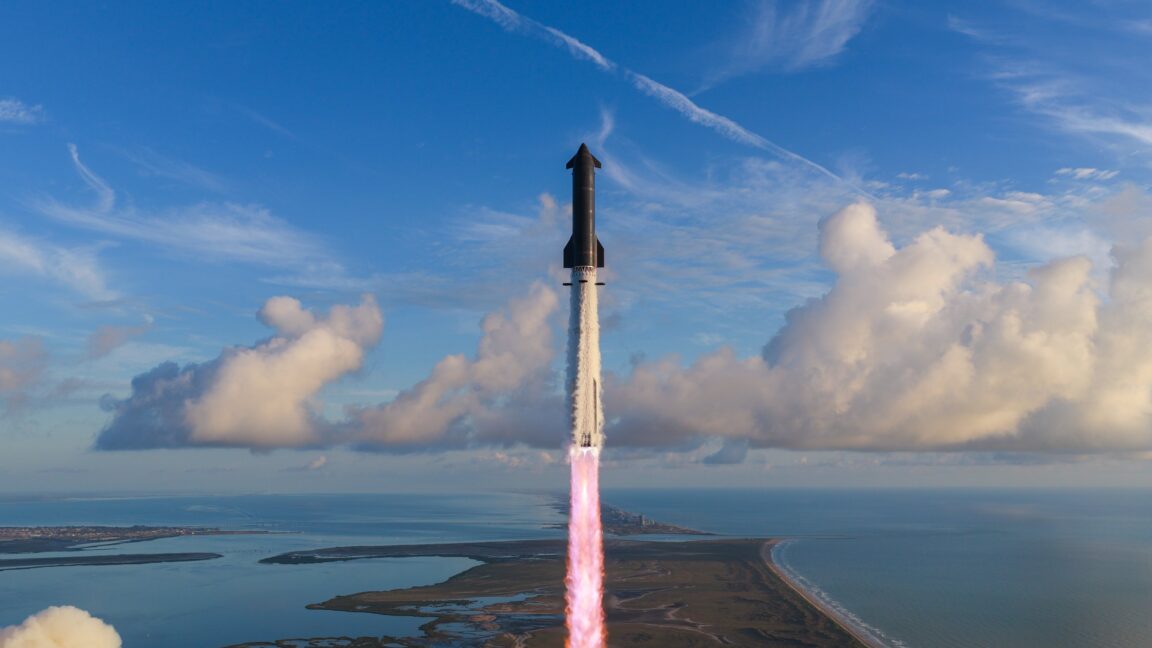

As the aerospace industry sets its sights on the next era of space exploration, SpaceX is gearing up for significant advancements in the functionality of its Starship rocket. Following its recent test flight, Gwynne Shotwell, President of SpaceX, announced plans for an early 2027 refueling test—pivotal for future lunar missions under NASA’s Artemis Program. This test aims to demonstrate how effectively Starship can be refueled in low-Earth orbit.
The necessity for this milestone stems from the fact that large-scale refueling in space is unprecedented. Data collected during this demonstration will help determine the efficiency of fuel transfers and the evaporation rates of crucial propellants like liquid oxygen and methane. Such insights are essential for understanding the logistics needed to support Starship’s operations on the Moon.
Aiming for High Flight Cadence
Looking ahead, SpaceX’s immediate goal is to increase the flight frequency of Starship. Elon Musk expressed his ambition for the rocket to achieve a “weekly” launch schedule in the first half of 2027, potentially escalating to two flights per week by year’s end. Central to this plan is the rocket’s reusability, an area Musk believes will transform current operational models.
“The rate at which we launch Starship will increase dramatically as we solve rapid and complete reusability,” Musk commented, highlighting the initial need for refurbishment between flights. His vision is for a future where rockets can be launched in rapid succession, akin to the operations of commercial airliners.
While the aspiration for complete reusability remains a bold challenge, overcoming the engineering hurdles involved could revolutionize space travel. SpaceX’s engineering team is expected to confront and navigate these complexities over time, inching closer to the feasible execution of rapid launches, landings, and re-flying of its rockets.
Throughout 2027, SpaceX will mainly focus on deploying its own payloads using the Starship. Shotwell confirmed that the company would continue to facilitate the launch of Starlink V3 satellites, which are designed to provide direct-to-cell connectivity services, along with data center prototypes known as Starmind in the coming year. Interestingly, neither Musk nor Shotwell addressed the contested throttling of Starlink services in Ukraine during recent discussions, leaving questions about its impact in ongoing geopolitical contexts.
Editor’s Take
The advancements in SpaceX’s Starship program signify a transformative moment for space exploration and commercial satellite deployment. Accelerating launch frequencies could enhance accessibility to space, benefiting various sectors, particularly telecommunications and data management. This evolution not only supports lunar ambitions but also poses questions about operational sustainability and international cooperation in space exploration.
Source: arstechnica.com