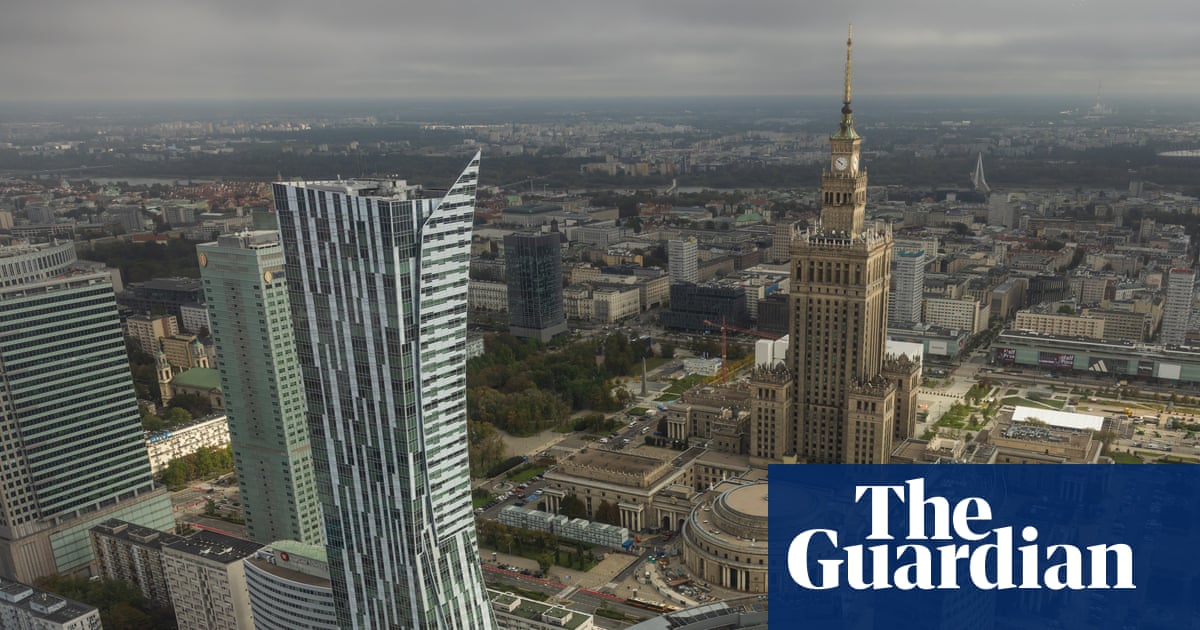

Perched over the rain-drenched streets of Warsaw, the observation deck of the Varso Tower provides a striking view of the Palace of Culture and Science, a Soviet-era structure that has sparked debate for decades. While some see it as a remnant of oppression, others regard it as a historical icon that serves as a reminder of Poland’s past.
The Varso Tower, which stands at a height of 310 meters, became the tallest building in the European Union when it was completed four years ago. Its development symbolizes Poland’s swift transition towards economic prosperity, with its structure towering over the palace that represents a bygone era of communism.
“We look down on it,” remarks Cezary Błaszczyk, managing director of HB Reavis, gesturing toward the Palace of Culture. A recent slackline stunt, where a walker traversed the 500-meter gap between the two buildings, was described by colleague Natalia Kasperska as a “symbolic walk from the past to the future.”
Błaszczyk explains, “The fact that we are higher than the Palace signifies that we have moved beyond communism and embraced a robust economy.” Over the past four decades, Poland has made significant strides since throwing off the shackles of Soviet rule. The country has experienced unprecedented economic growth, with average incomes rising from just 40% of the EU average in the mid-1990s to 81% last year.
As of last year, Poland’s national income exceeded $1 trillion, propelling the country into the ranks of the world’s 20 largest economies. Projections from the International Monetary Fund suggest that Poland’s income per capita may soon surpass that of Japan and Spain.
“Four decades ago, we were in – excuse my English – deep, deep trouble,” reflects Marcin Bosacki, Poland’s deputy foreign minister, as he recalls his own experiences from the 1980s when citizens had to queue for hours to buy essential goods under a communist regime. Events like the rise of the Solidarity movement and Pope John Paul II’s pivotal pilgrimage back to Poland in 1979 played crucial roles in catalyzing the country’s transition to democracy in 1990, paving the way for an economic renaissance.
Since then, Poland has integrated into major Western institutions, joining NATO in 1999 and the EU in 2004, which have both significantly aided its modernization and prosperity.
Despite the initial brain drain, where many Poles opted to seek better opportunities abroad post-EU accession, the trend is shifting. Before Brexit, Polish migrants were often seen filling labor shortages in the United Kingdom, but recent statistics show that more Poles are leaving the UK than arriving since 2021.
In the Varso’s offices, architects Jedrzej Kolesinski and Krzysztof Gornicki, who returned to Poland after working in London, affirm that the nation has transformed dramatically. Kolesinski states, “You can now work globally from here. We are doing the same projects from Warsaw that we used to from London.”
The dynamic changes in Warsaw are palpable, with contemporary electric trams running alongside skyscrapers and construction sites. The traditional bar mleczny (milk bars) continue to thrive, serving classic Polish dishes, albeit with upgrades like touchscreen ordering systems.
Yet, this rapid growth is not without its challenges. Rising living costs have begun to push out lower-income residents, creating growing inequality that is among the highest in Europe. Political tensions are also brewing ahead of a divisive general election next year, as nationalist sentiments clash with liberal values.
As Poland transitions from being a low-cost manufacturing hub to a more knowledge-based economy, the average monthly wage has tripled since 2004. Now sitting at 8,904 złoty, the cost of living has surged, with prices for essentials and services even exceeding those in cities like Tokyo.
Billionaire entrepreneur Rafał Brzoska emphasizes that the future will rely less on low labor costs and more on innovation and productivity. “We need to focus on technology, energy efficiency, and better regulations,” he asserts.
Efforts are underway to bolster Poland’s status as a regional tech hub through substantial investments aimed at supporting tech startups and advancing artificial intelligence initiatives. The increasing number of high-growth companies reflects Poland’s growing potential in these fields.
On the eastern bank of the Vistula River, the campus of game developer CD Projekt Red showcases the ingenuity present in the Polish tech landscape. Co-CEO Michał Nowakowski recalls the nation’s more humble ambitions in the 1990s, juxtaposing it against today’s competitive global environment.
“For the new generation, there is no inferiority complex; they have the skills and education needed to compete,” he notes. With so many skilled graduates and progressive educational standards, the vision of a thriving tech-centric Poland seems increasingly realistic.
Editor’s Take
This development underscores the significant transformation Poland has undergone, transitioning from its communist past to a burgeoning tech economy. As businesses eye Poland for talent and innovation, this shift could benefit users and developers seeking opportunities in a dynamic market. It highlights the importance of adaptability in a globalized world, where success hinges on smart investment in skills and technology.
Source: www.theguardian.com