Missile Strikes Saudi Airport Following Houthi Attack That Killed 13, Injured Hundreds

Riyadh’s international airport was struck again by a missile, raising tensions in the region as Donald Trump considers possible military action in response to escalating attacks from Houthi rebels in Yemen. This latest incident resulted in one fatality and left 11 others injured.
The Houthi militia has claimed responsibility for the strike, which occurred just a day after a separate assault on King Khalid International Airport resulted in the deaths of 13 and injuries to over 300 individuals. These assaults have marked a significant increase in hostilities in the ongoing conflict between Houthi forces and Saudi Arabia.
The Saudi-led coalition, engaged in military efforts against the Iran-backed Houthis, reported that air defenses successfully intercepted a missile over Riyadh on Sunday. The projectile reportedly impacted Terminals 4 of the airport, leading to a fire.
In a statement, coalition spokesperson Major General Turki al-Malki confirmed that the projectile hit the airport and noted that air defenses also thwarted another cruise missile aimed at the capital.
Trump commented on the situation, stating he would evaluate potential countermeasures, saying, “We just found out about the recent attack, so we’ll make a decision. We move very quickly.”

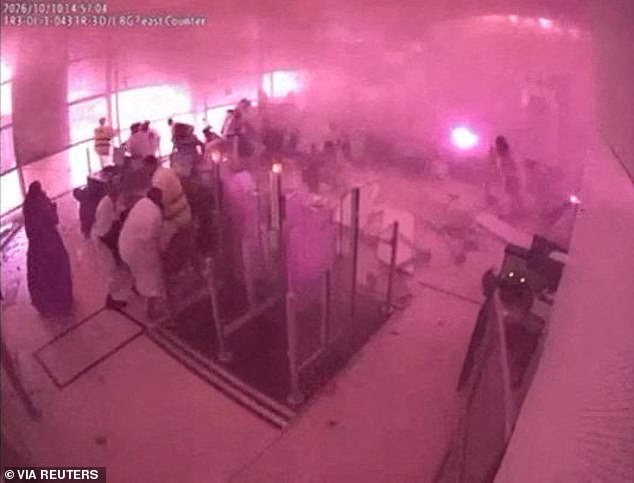
Surveillance footage shows smoke and fire as people react at the moment of an attack at King Khalid International Airport in Riyadh
The Iranian-aligned Houthis issued a statement asserting they had executed multiple missile and drone operations targeting both the airport and Saudi energy facilities over the weekend. Military spokesperson Yahya Saree indicated that the group had conducted “four qualitative operations” in a 24-hour span.
Saudi Arabia’s civil aviation authority condemned the assault, labeling it a “heinous attack” that led to significant property damage and casualties. Among the deceased was a Pakistani national, while the total death toll from Saturday’s attacks has risen to 13, including an Indian citizen as confirmed by the Indian embassy.
In the wake of these violent incidents, the UK government has issued travel advisories urging citizens to avoid King Khalid International Airport until it is deemed secure.
This latest onslaught is part of a broader pattern of aggressive Houthi actions following the collapse of a ceasefire agreement in July, which has seen them strike multiple Saudi facilities with increasing frequency.
Amplifying the depth of this conflict, Marco Rubio, the US Secretary of State, denounced the recent attacks, underscoring a commitment to supporting Saudi Arabia against what he termed terrorist actions. He reaffirmed that these assaults endanger civilian lives and must cease immediately, reiterating US solidarity with the kingdom.
The strikes represent the most severe offensive in the region since the onset of the US-Iran war and have raised concerns over potential retaliation. The situation remains volatile, with implications for regional stability, especially considering scheduled high-profile events in Saudi Arabia.
Editor’s Take
This escalating conflict serves as a reminder of the volatile geopolitical landscape in the Middle East. As the situation intensifies, it poses not only risks to regional stability but could also impact energy markets globally. For those involved in international business, preparedness for sudden shifts in conflict and travel advisories will be key in navigating this increasingly dangerous environment.
Source: www.dailymail.com