

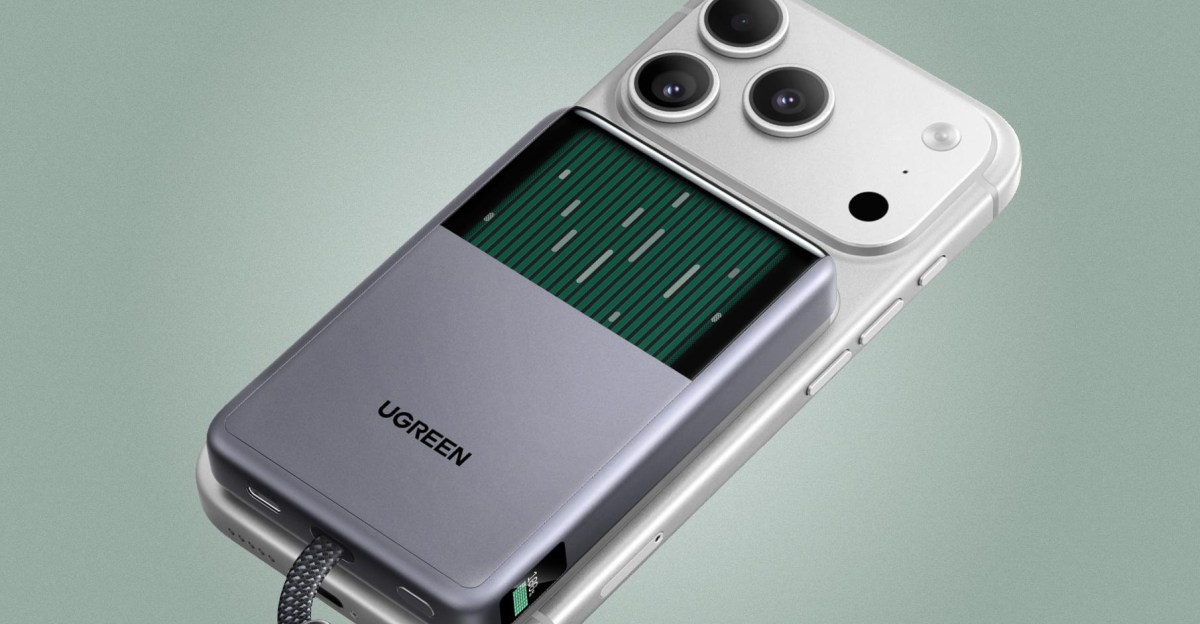

The MagFlow Pro Magnetic Power Bank from Ugreen has officially launched, featuring innovative technologies that promise to revolutionize mobile charging. Priced at $149.99, this power bank may seem pricey for its 10,000mAh capacity, but it introduces unique features that set it apart from conventional counterparts.
Central to the functionality of the MagFlow Pro is its advanced liquid-cooling system, reportedly the first of its kind in a power bank designed for wireless charging. This system utilizes a micro-pump to circulate coolant, effectively managing heat generation from the device’s Qi2.2-compatible wireless charging coil. Users will notice a distinct “Cyber Window” on the front, allowing them to see the coolant in action as it flows.
Additionally, the design includes copper foil and strategically spaced components to minimize heat buildup, which in turn helps prolong the battery life of both the power bank and connected devices. This innovative approach aims to maintain efficient performance, enabling the MagFlow Pro to deliver up to 25 watts of power while keeping temperatures manageable.
Beyond wireless capabilities, the MagFlow Pro is equipped with a built-in USB-C cable and a USB-C port, each capable of outputting up to 45 watts when charging devices through a wired connection. However, it’s important to note that the maximum output remains at 45 watts; thus, connecting multiple devices will reduce charging speed.
Editor’s Take
The introduction of Ugreen’s MagFlow Pro signifies a notable shift in power bank technology, bringing advanced cooling systems into a market ripe for innovation. This could alleviate concerns about overheating during prolonged use, particularly for users who rely heavily on mobile devices. For businesses and developers, it highlights a growing trend towards integrating cutting-edge thermal management solutions in consumer electronics, offering new avenues for product differentiation.
Source: www.theverge.com