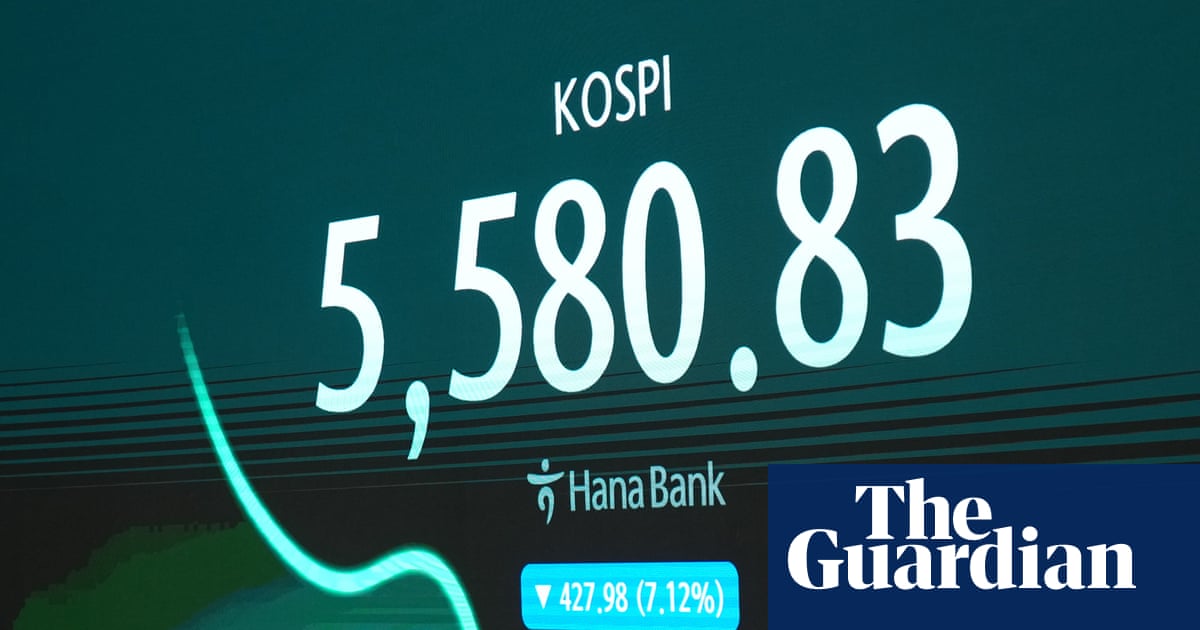

Global markets are experiencing significant turmoil due to a sharp sell-off in AI-linked shares, driven by rising concerns over inflation and anticipated interest rate hikes. Traders are particularly anxious about the heavily indebted nature of the AI sector, which has begun to show cracks.
In South Korea, the Kospi 200 index, heavily weighted towards memory chip manufacturers, plunged over 8% overnight, closing at its lowest level in six months. Trading was halted multiple times due to circuit breakers as stocks like SK Hynix and Samsung Electronics suffered declines of nearly 11% and 9.5%, respectively, leading to a final drop of 8.1% for the index.
Similarly, Japan’s Nikkei 225 fell by 4.9% on Thursday, following a staggering 11% drop in memory chip maker Kioxia and a 10% decline in SoftBank, a major investor in OpenAI, the owner of ChatGPT.
The declines in Asia came after Wall Street experienced a downturn the previous day, with the Nasdaq Composite dropping 1.9% and the S&P 500 declining by 1.1%, marking its worst performance since July.
This market slide was ignited by U.S. inflation data that revealed a rise to 3.7% in September, a rate higher than expected and the fastest increase in prices since May. The figure has unsettled investors, many of whom are predicting imminent interest rate hikes by the Federal Reserve, with expectations for another increase possibly as soon as the end of this month.
“Markets have just had an incredibly tumultuous 24 hours,” said analysts from Deutsche Bank led by Jim Reid. They noted that a strong U.S. CPI reading combined with growing fears surrounding the AI sector has created a perfect storm.
It’s concerning to note that the inflation figures are not solely driven by escalating fuel costs, which have been affected by geopolitical tensions, particularly linked to the conflict involving Iran. Reid emphasized that the rising prices reflect broader increases across various consumer goods.
The International Monetary Fund recently warned that the repercussions of an AI share price crash could pose a significant risk to global financial stability. The IMF specifically pointed out that while the U.S. market faces the brunt of these repercussions, Asian markets could also be significantly affected, whereas the UK and eurozone may be somewhat insulated.
In China, the Shanghai Shenzhen CSI 300 index fell by as much as 2.4%, reaching its lowest point since August 2025. Taiwan’s leading chip manufacturer, TSMC, also saw a decline of 2%, despite announcing its sixth consecutive quarter of profit.
European stocks opened lower as well, with the Europe Stoxx 600 down by 0.4%, the UK’s FTSE 100 down by 0.06%, France’s CAC 40 dropping by 0.19%, and Spain’s Ibex sliding by 0.17%. Germany’s DAX index experienced a decline of 0.53%.
In the U.S., stock futures indicated a challenging day ahead for tech stocks, with Nasdaq 100 futures retreating by 1%.
Editor’s Take
The current market turbulence underscores the interconnectedness of the AI sector with broader economic conditions. For businesses and developers in the AI field, these shifts may lead to a reevaluation of investment strategies and project funding. Users might also feel the effects as firms may reconsider pricing and product releases in response to heightened economic uncertainties.
Source: www.theguardian.com