

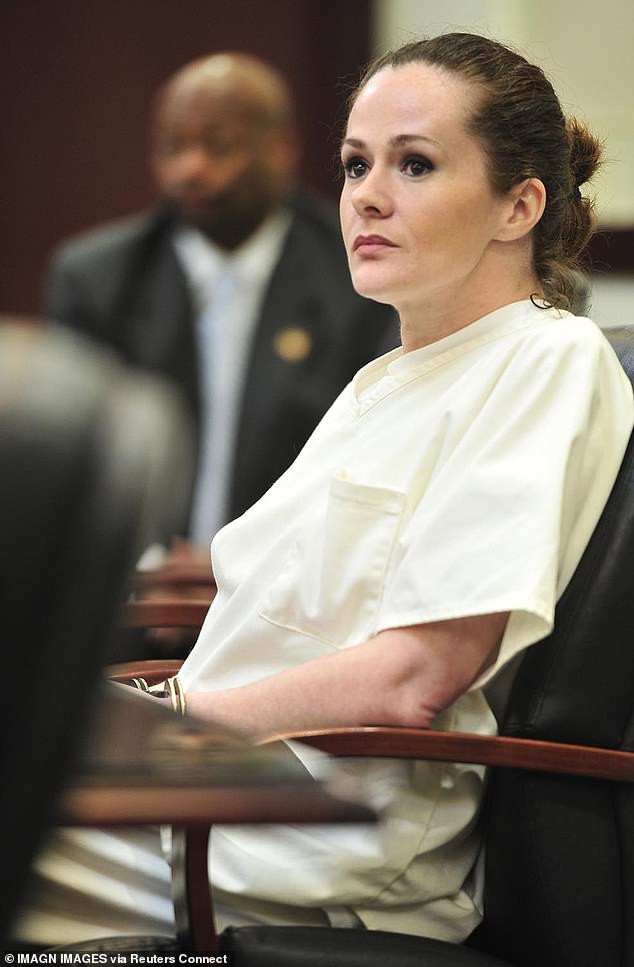
Christa Pike’s Hospital Guarded Amid Concerns of Long-term Recovery from Execution

Christa Pike, a convicted murderer, is currently under heavy guard in a hospital following a problematic execution attempt, as reported by her legal representatives. Pike, who was sentenced to death in Tennessee in 1996 for the brutal murder of her classmate, Colleen Slemmer, is said to be in a critical condition with little chance of recovery.
The execution, originally scheduled for September 30, had been postponed multiple times over the past three decades. At age 50, Pike reportedly underwent a lethal injection involving at least seven needles as medical personnel struggled to administer two doses of pentobarbital. Eyewitnesses and court documents indicate that she was vocal during the process, experiencing pain and distress.
Once members of the media were dismissed from the viewing area at 8:53 PM, it was noted that Pike was snoring loudly behind the curtains. She was later transported to the hospital in an unconscious state, suffering from swollen and blistered arms due to the injection process. Currently, she remains on a ventilator but has not regained consciousness, as indicated by her attorney, Stephen Ferrell.
Ferrell informed CNN that Pike’s room is under close supervision and conveyed concerns that she may never fully recover from this incident. “We are still uncertain about her long-term prognosis,” he added. Despite her critical condition, her legal team has not been granted access to her hospital room, leaving them in the dark regarding her status.
As of now, the state of Tennessee has not declared its intentions regarding another execution attempt. Ferrell has urged the governor to consider commuting Pike’s death sentence to life in prison, citing the extreme mental and physical suffering that she has endured, particularly during the execution attempt.
Pike’s attorneys have drawn attention to statements made by her during the botched execution, which included exclamations of discomfort. The procedural failure, which did not outline steps for dealing with an inmate who survives lethal injection, led to widespread scrutiny of the state’s execution protocols.
This unfortunate event has sparked controversy, garnering remarks from former President Donald Trump, who questioned how such a failure could occur. As a result of the backlash, Frank Strada, the commissioner of the Tennessee Department of Correction, has announced his resignation effective later this month, stating it was a “great honor” to serve.
In their legal filings, Pike’s lawyers argue that the execution team mishandled the IV lines, which they assert contributed to the lethal drug not being effectively administered. They are currently seeking to preserve all evidence from the flawed execution to protect Pike’s rights and ensure accountability.
According to Tennessee’s execution protocols, a backup set of drug syringes is to be administered if the inmate does not die after the initial dose, yet no guidance is provided for scenarios in which the subject remains alive after subsequent injections.
Governor Bill Lee has called a halt to further executions this year and initiated an independent review to examine the circumstances surrounding this incident. Since her conviction, which stemmed from an incident where she lured Slemmer to an isolated university area and inflicted extreme violence, Pike’s case has become a focal point of debate regarding the ethics of capital punishment.
Editor’s Take
The botched execution of Christa Pike raises serious questions about the procedures governing capital punishment in Tennessee and beyond. This incident not only highlights potential flaws in execution protocols but also invites scrutiny into the ethical implications of such practices. A review of these procedures could lead to significant changes in how states approach the death penalty, thus impacting future legal frameworks and the broader conversation about human rights.
Source: www.dailymail.com