Blue Origin Develops Cost-Effective Rocket Engine Promising Enhanced Performance

Blue Origin Enhances New Glenn Rocket: Cost-Effective Solutions for Space Launches
KENNEDY SPACE CENTER, Fla. — On Thursday, Blue Origin unveiled substantial advancements to its New Glenn rocket, aimed at streamlining manufacturing costs and increasing its payload capabilities for missions to geostationary orbit as well as lunar destinations.
The company has ambitious plans, seeking to position the New Glenn for over 1,000 launches annually, responding to the unprecedented demand for space access. “There has never been higher demand for launch, ever,” stated Dave Limp, CEO of Blue Origin, during the UP.Summit conference held at Florida’s Shuttle Landing Facility.
Introduction of the Northstar Engine
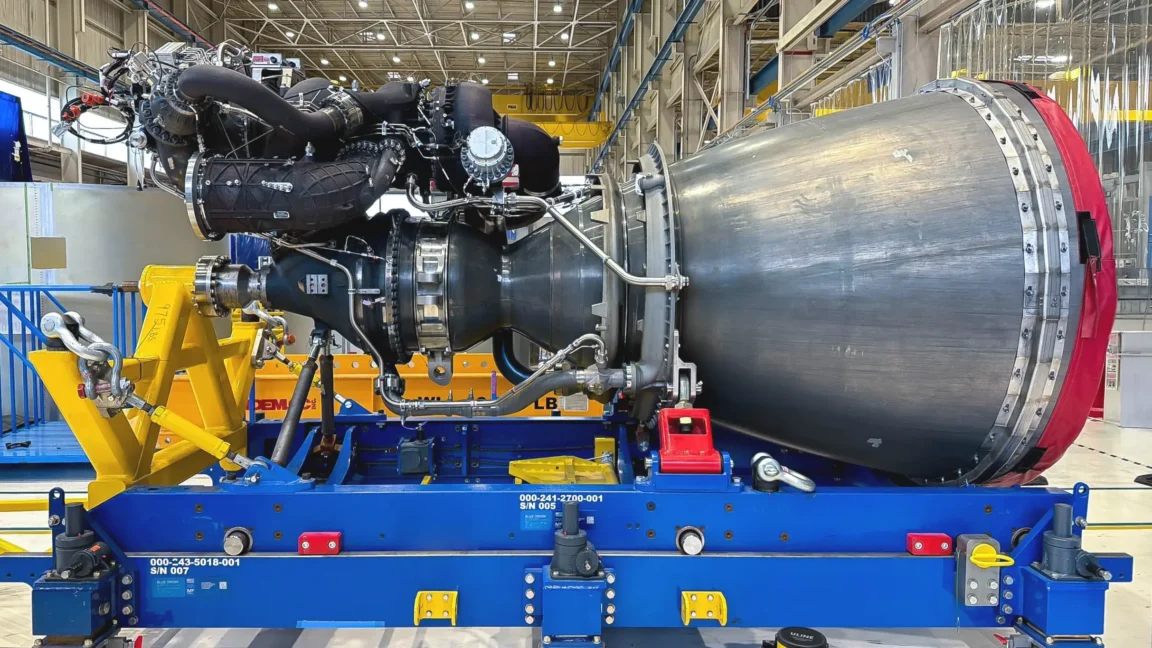
Among the key developments is the commencement of test firings for a new engine designated the Northstar. This engine is set to replace the current BE-4 engine that powers the first stage of the New Glenn rocket. Additionally, Blue Origin announced the creation of a new hydrogen-oxygen third stage, referred to as GS3, which aims to enhance the rocket’s performance.
The Northstar engine, as described by Limp, is a more streamlined and effective successor to the BE-4. It boasts half the number of components, a 30% reduction in weight, and approximately 65% of its parts can be manufactured using 3D printing technology.
Blue Origin estimates that the production costs for the Northstar could potentially be reduced to 25% of the current expenses associated with the BE-4, with aspirations to achieve assembly times of less than one day per engine. With ongoing tests already underway, Limp is optimistic about the future, noting, “To get access to space at a lower cost, we have to look at every part of the vehicle. This is going to be a game-changer.”
The current BE-4 engine delivers a thrust of 640,000 pounds, whereas the new Northstar will start with a thrust capability of 715,000 pounds. Similar to its predecessor, the Northstar will burn a combination of methane and liquid oxygen, utilizing an oxygen-rich staged combustion cycle along with a single-shaft turbopump design.
Blue Origin will continue the production of the existing BE-4 engines for United Launch Alliance, which relies on two of these engines for its Vulcan rocket.
Editor’s Take
The advancements in the New Glenn rocket, particularly with the introduction of the Northstar engine, are significant for the space industry, promising lower launch costs and increased efficiency. This could democratize access to space for a wider array of businesses and research institutions, thereby accelerating innovation and exploration. For developers and companies in the AI field, the enhanced capabilities could lead to a surge in satellite deployments, paving the way for improved data collection and analysis applications in diverse sectors.
Source: arstechnica.com