

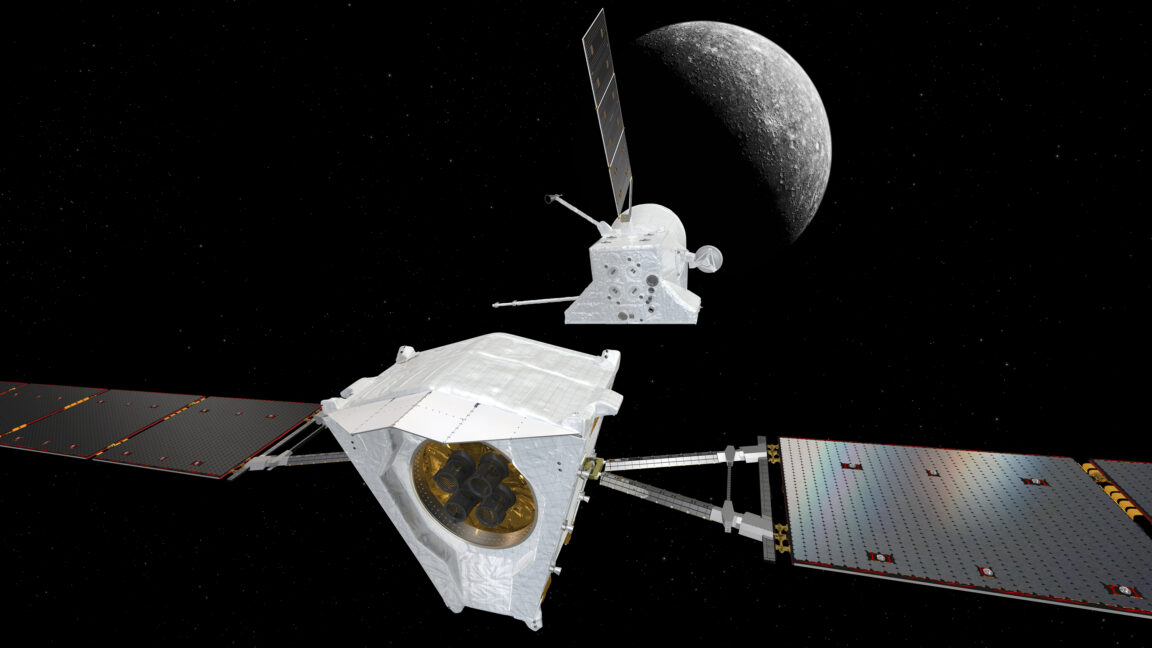

The BepiColombo mission, a collaborative effort between European and Japanese space agencies, has recently completed a significant milestone by detaching its propulsion module as it approaches its orbit around Mercury. This unique mission involves three spacecraft in total: the Mercury Transfer Module and the Mercury Planetary Orbiter from Europe, alongside the Mercury Magnetospheric Orbiter, affectionately referred to as Mia, from Japan.
The successful separation of the propulsion module took place on Thursday, allowing the two operational orbiters to continue their journey together. They are expected to part ways in December once they reach their designated orbit around Mercury. Each orbiter is equipped with distinct scientific instruments for observations, while the transferred module is no longer necessary for the mission.
Credit: ESA/BepiColombo/MTM
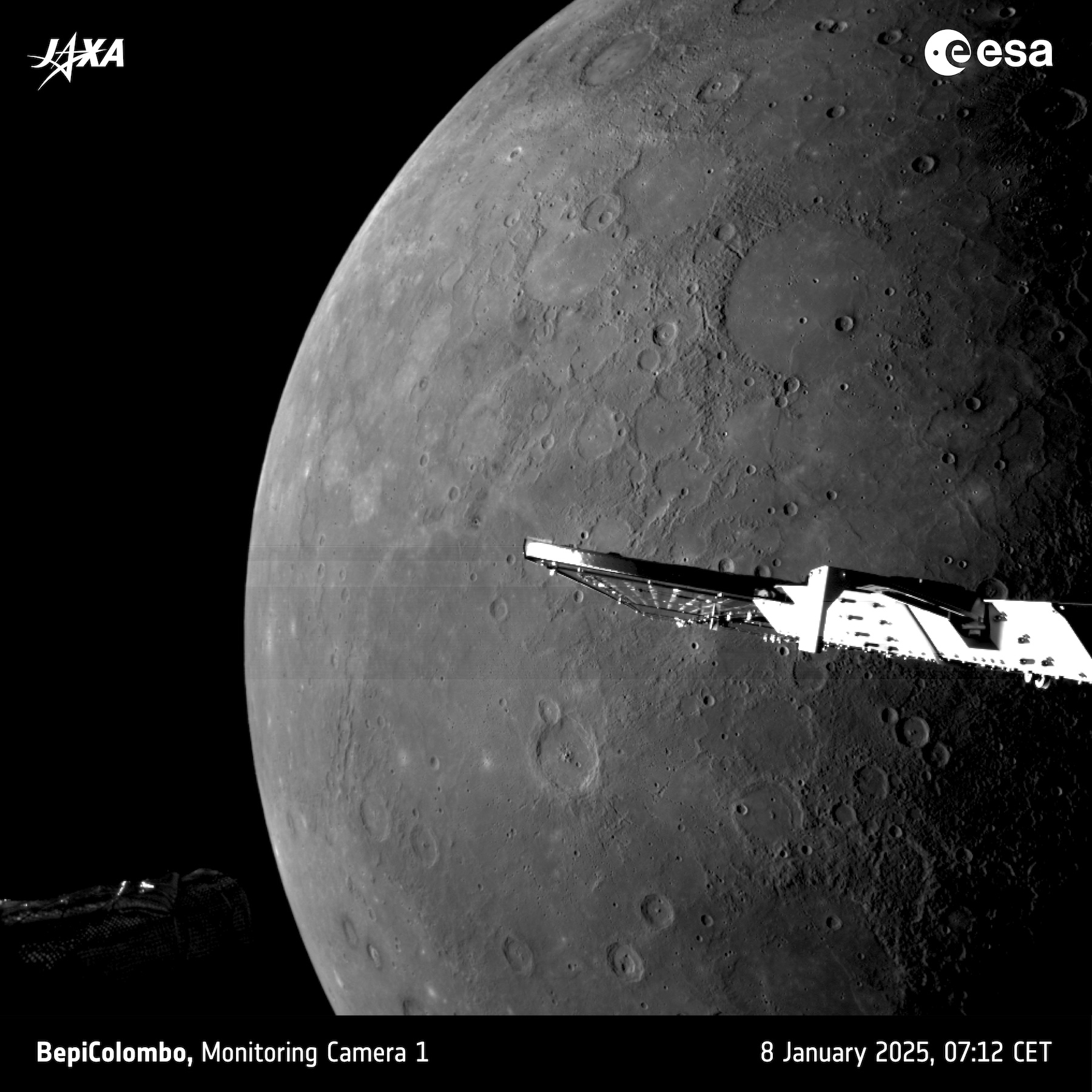
A monitoring camera onboard the Mercury Transfer Module captured this view of Mercury’s cratered surface during a flyby on January 8, 2025.
Credit: ESA/BepiColombo/MTM
Challenges of a Hostile Environment
Accomplishing the separation of the propulsion module in the vicinity of Mercury presents a groundbreaking achievement, especially given the extreme conditions found there. The maneuver occurred approximately 39 million miles (63 million kilometers) from the Sun—less than half the distance of Earth—exposing the spacecraft to intense solar radiation and drastic temperature variations.
According to Ignacio Tanco, the head of inner Solar System mission operations at ESA, executing this separation is akin to launching a new spacecraft, replete with significant risks. Upon detachment, the remaining spacecraft will assume control over power generation, propulsion, pointing, and thermal management—all vital aspects when operating in such close proximity to the Sun.
Tanco emphasized, “We will only know if it was successful after the separation, utilizing new sensors and mechanisms as we adjust our attitude control system.” Notably, some mission science instruments, including the most advanced cameras, were blocked by the propulsion module during transit to Mercury. The upcoming separation will allow these instruments to finally commence their observations.
Editor’s Take
The success of the BepiColombo mission underscores the resilience and ingenuity of space exploration technologies. Navigating the harsh environment near Mercury not only paves the way for new scientific discoveries but also demonstrates the collaboration between international space agencies. Such advancements are vital in enhancing our understanding of the solar system and could have broader implications for future deep-space missions.
Source: arstechnica.com