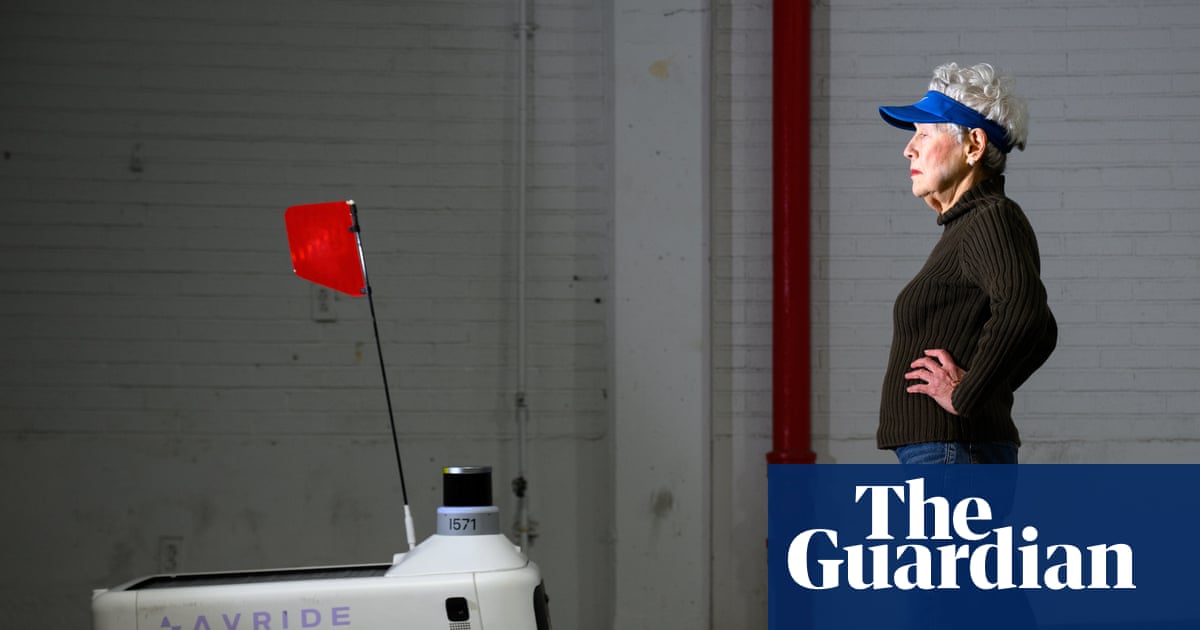

On a brisk autumn morning in Philadelphia, 78-year-old Carolyn Marvin prepares for her latest mission: disrupting food delivery robots. Clad in her signature blue visor, the semi-retired communications professor from the University of Pennsylvania has become a well-known figure in her community for her spirited protests against these robotic couriers.
Marvin frequently positions herself in the path of the UberEats robots that are increasingly common in the city’s downtown. With a dedicated approach, she aims to draw attention to what she perceives as the encroachment of automation into public spaces. “I have a life,” she emphasizes, yet her resolve to confront these machines whenever they appear is unwavering.
Her antics, which have garnered both admiration and backlash, were taken to new heights when some locals dressed as Marvin and the robots for Halloween. However, her protests have not been without consequence. Recently, she faced legal trouble when the police were called due to her interference with a robot in a high-traffic area, leading to an encounter that left her handcuffed and ticketed for disorderly conduct.
Reflecting on her arrest, Marvin recalls, “I told the officers it was my First Amendment right to protest against corporations in public spaces.” While the arresting officers appeared confused about the legality of her actions, they ultimately issued her a ticket. Marvin plans to contest the charges vigorously, seeking to make her case about the implications of robots in urban life.
Though the exact number of food delivery robots in Philadelphia remains unclear, the city has seen an increase fueled by companies like Avride, which operates a fleet of around 1,000 robots across various urban locations. These robots are designed to blend into their environments, equipped with screens that display friendly graphics to “humanize” them and evoke a sense of comfort among pedestrians.
Marvin remains undeterred by these efforts. While waiting for a robot’s activation, she expresses her concerns: “I think robots are fine in factories, but they don’t belong on our streets.” The professor highlights the importance of public opinion in the discussion surrounding the use of robots in shared spaces, indicating that cities like Toronto have already taken proactive measures by banning these devices from sidewalks.
As she successfully blocks one of the delivery robots, passerby reactions vary—from curiosity and support to indifference. Young adults cheer her efforts, while children are captivated by the quirky design of the robots, revealing a generational split in perspectives on automation.
The growing unease about AI and automation is echoed in a recent survey from Pew Research, where a majority of Americans expressed skepticism about AI’s impact on society. Marvin’s actions resonate with a populace increasingly wary of replacing human jobs with automated solutions.
With robots being slowly normalized in public spaces, Marvin’s protests serve to remind people about the potential implications of automation. Her resolve encapsulates a pressing debate about the future of public infrastructure and the role of automation in society.
Ultimately, Marvin’s approach may shape how citizens interact with automated technology and advocate for both their rights and urban policies, sparking ongoing discussions about what public spaces should prioritize: efficiency or community needs.
Editor’s Take
This development highlights the essential discourse surrounding AI and automation in public spaces. As we witness a burgeoning presence of delivery robots, questions about their societal implications become increasingly relevant. The balancing act between technological advancement and public sentiment must be navigated thoughtfully, signaling potential for significant changes in how our cities are designed and governed.
Source: www.theguardian.com