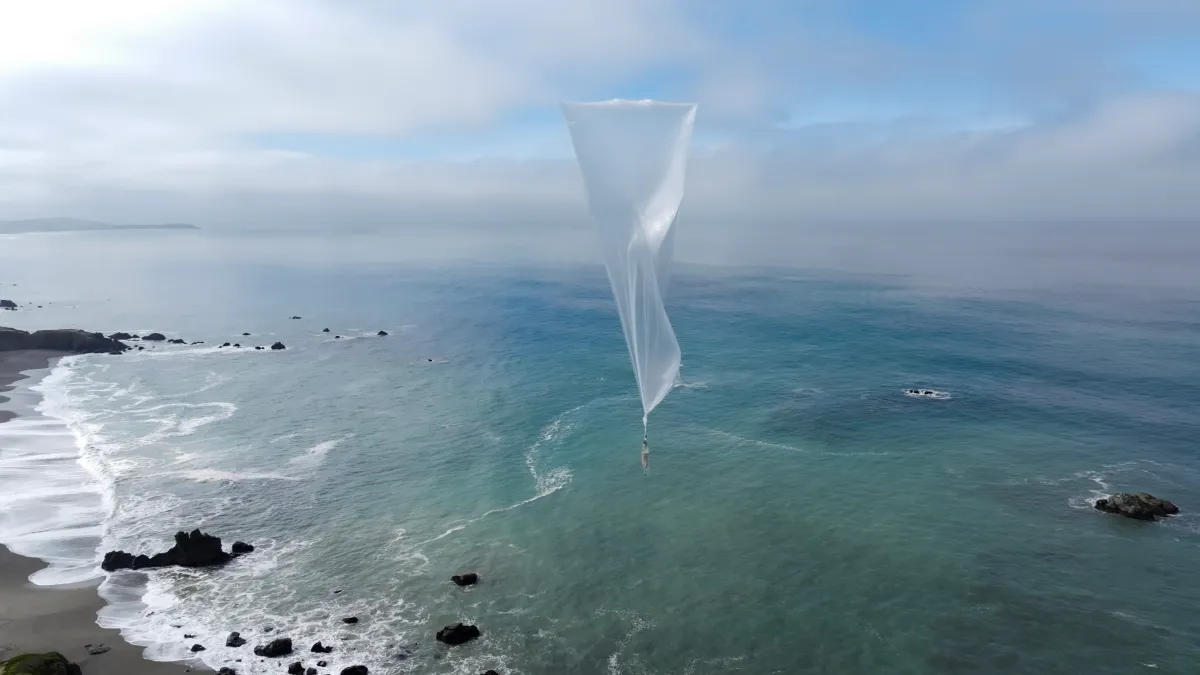

The U.S. Air Force has announced a significant contract with WindBorne Systems, a startup specializing in autonomous weather balloons, which could amount to nearly $50 million. This partnership will see the Air Force purchase atmospheric data gathered by WindBorne’s fleet of approximately 700 balloons operating globally.
Founded in 2015 and headquartered in Redwood City, California, WindBorne is known for its innovative use of empirical data to enhance its deep-learning weather forecasting model. The company supplies its data to various customers, including the National Weather Service and the military.
While the contract is valued at up to $49 million, the Air Force will only pay for data as needed, enabling it to issue orders for specific regions and times. WindBorne has thus far received $1.7 million worth of orders, with expectations for further requests forthcoming.
Andrey Sushko, WindBorne’s co-founder and CTO, remarked that this contract facilitates the company’s growth and ongoing research and development efforts aimed at enhancing the balloons’ capabilities. He noted that this award was granted without competitive bidding, signifying the government’s recognition that WindBorne is uniquely qualified to meet their data collection needs.
WindBorne’s CEO, John Dean, had previously disclosed that the company raised $37 million in a Series B funding round to scale their operations. This past summer, WindBorne introduced WeatherMesh 6, the latest iteration of its forecasting model, claiming it surpasses traditional methods utilized by the European Centre for Medium-Range Weather Forecasts (ECMWF) in accuracy.
With the advent of transformer model architectures, AI-driven weather forecasting has demonstrated significant advancements, allowing models to process extensive historical weather data for faster and more accurate predictions. While forecasts generated by AI models from leading labs and government entities show promise, both traditional and modern systems continue to play essential roles in weather analysis.
In an unprecedented achievement, WindBorne recently became the first organization to deploy an unpowered flight system into the eye of a typhoon to gather data. The ability to navigate these balloons effectively relies on sophisticated weather models and a sufficient number of balloons positioned strategically across various locations.
Sushko explained that this achievement marks a novel application of deep learning in operational weather data collection, signifying a leap forward in meteorological practices.
Editor’s Take
This contract not only emphasizes the U.S. government’s reliance on innovative technology for enhanced weather forecasting but also showcases the potential for AI and machine learning in operational environments. As companies like WindBorne expand their capabilities, users and developers alike might benefit from more accurate predictive models, which could lead to improved responses during severe weather conditions.
Source: techcrunch.com