


Neanderthal Wooden Tools Discovered in Spain Offer Insights into Early Human Life
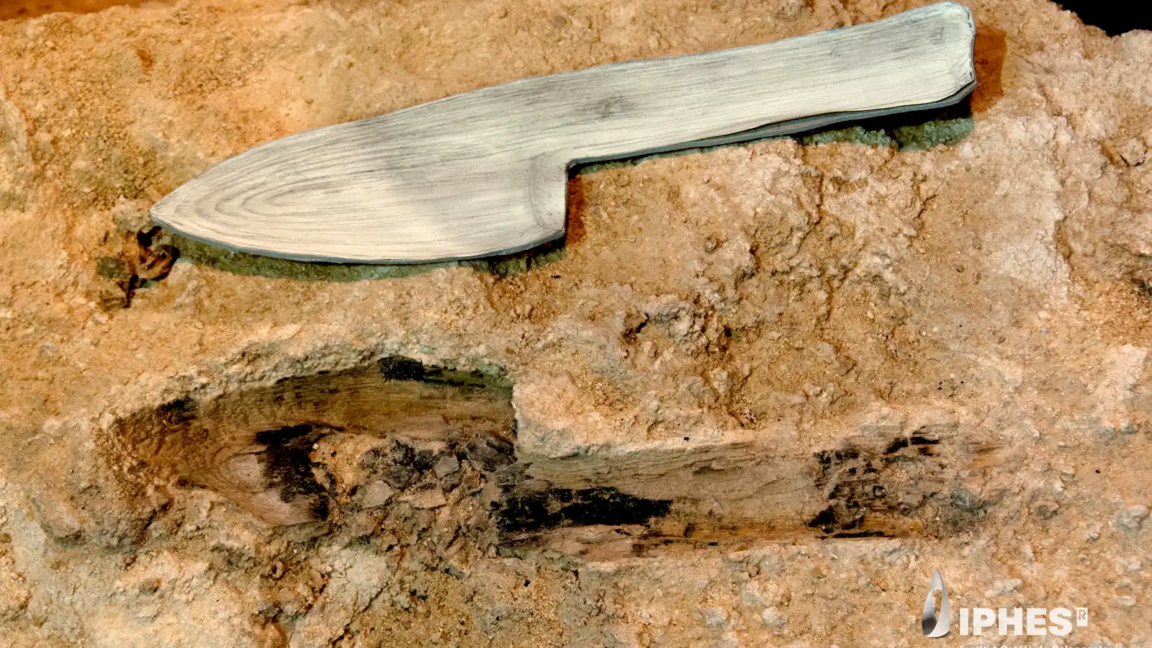
The name of the Stone Age derives from the tools that have survived through the centuries, but early humans likely relied heavily on wood, which is much simpler to manipulate. Unfortunately, our understanding of Paleolithic woodworking is limited due to the rapid decay of wooden materials. However, at Abric Romaní, a rock shelter located west of Barcelona, researchers have made a groundbreaking discovery. Mineral-rich water that coated ancient wooden tools in a crust similar to limestone has preserved the molds of these artifacts, providing invaluable insights.
A recent study published in Science Advances by a team of Spanish archaeologists has cataloged a remarkable 597 wooden artifacts discovered in Neanderthal living quarters, dating between 62,000 and 40,000 years ago. These findings include a variety of items, such as spears, digging sticks, bark trays, components of shelters, and an unusual club, which indicate that Neanderthals possessed more sophisticated skills than previously believed.
More than Just Hunting Tools
While many of the oldest known wooden artifacts are primarily weapons—including notable finds such as spears from Schöningen in Germany, a spear tip from Clacton-on-Sea in England, and another found with an elephant skeleton in Lehringen, Germany—most were recovered from anaerobic environments that slowed their decay.
The artifacts unearthed at Abric Romaní, however, provide a broader perspective on Neanderthal existence. This location served as a long-term habitat where Neanderthals lived, slept, cooked, and crafted tools over a span of roughly 20,000 years.
According to M. Gema Chacón, an archaeologist at the Catalan Institute of Human Paleoecology and Social Evolution (IPHES-CERCA) and co-author of the study, “We have a sample of wooden tools for different subsistence activities, not only hunting.” The consistent appearance of wooden tools across various layers of deposits suggests that woodworking was a routine activity for Neanderthals, rather than a sporadic endeavor.
Editor’s Take
This discovery not only enriches our understanding of Neanderthal life but also challenges the traditional perceptions that view them as less sophisticated than early Homo sapiens. The diversity of tools indicates a complex lifestyle that included various subsistence strategies. Such findings may have significant implications for how we view human evolution, potentially reshaping discussions in anthropology and related fields.
Source: arstechnica.com