
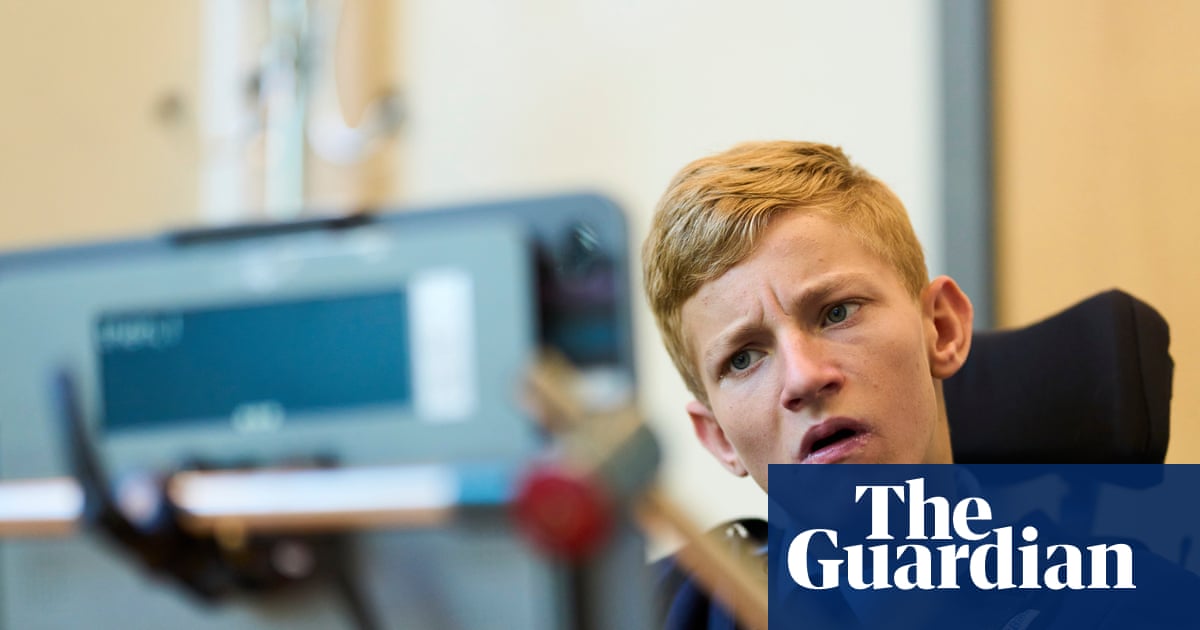

Patrick McCabe, a 16-year-old student with cerebral palsy, has become a beacon of inspiration following his remarkable success in achieving seven GCSEs at Fallibroome Academy in Macclesfield, Cheshire. This summer, he completed his exams using advanced eye-tracking technology, a process that took four arduous months. Now, he has embarked on a new academic chapter as he begins his A-levels in French, business, and media studies, facing fresh challenges ahead.
Patrick’s vibrant personality shines through as he interacts with his fellow classmates, enjoying the camaraderie of school life. He expresses gratitude for the inclusive educational environment, stating, “The best thing has been that, just like my big brothers, I’ve been able to learn and develop skills.” However, he candidly acknowledges the difficulties he has faced, particularly in building lasting relationships due to communication barriers.
His experiences underscore both the aspirations of the Labour government’s broader strategy for students with special educational needs and the significant changes required to make education truly inclusive. While reforms aim to keep students in local mainstream schools, the reality is that Patrick’s journey highlights ongoing challenges. His family and school administrators contend that vital support and funding are often inadequate, making the path to success uphill for many.
His headteacher, Ross Martland, emphasized the need for fairness, saying, “All we wanted was for Patrick to have the opportunity to demonstrate his knowledge.” However, Patrick faced an exhausting exam schedule that stretched from February through June, contrasting sharply with the typical experiences of his peers, who had more time to prepare their studies.
For Patrick, completing even a single exam question could stretch to six hours. He was continually supported by CandLE, an organization dedicated to helping students with augmentative and alternative communication (AAC) technology. Ultimately, he triumphed, achieving the grades necessary for his progression into sixth form.
Revising for exams proved to be particularly strenuous. Patrick shared, “I felt I had to work harder to express what I know…” which added to both his mental and physical fatigue. Nevertheless, he remained committed to showcasing his capabilities.
While Patrick is optimistic about his transition to sixth form and appreciates the school’s support, he acknowledges that concerns about social connections linger. He believes that assessments for students using eye-tracking technology should be adapted to remove additional hurdles they face.
Looking ahead, Patrick aspires to study media at university, showing eagerness for what lies ahead. He is particularly drawn to the subject, stating, “I find it interesting, and I’d like to go into the industry.” The options for higher education spark his excitement, as he considers institutions far and wide, underscoring his determination to pursue his dreams.
Editor’s Take
This story illustrates the vital intersection between education and technology, especially regarding accessibility. Patrick McCabe’s journey highlights the need for continued adaptation in educational frameworks to support all learners effectively. As technology evolves, the capacity to enhance learning experiences for students with disabilities becomes increasingly crucial, impacting users and institutions alike.
Source: www.theguardian.com