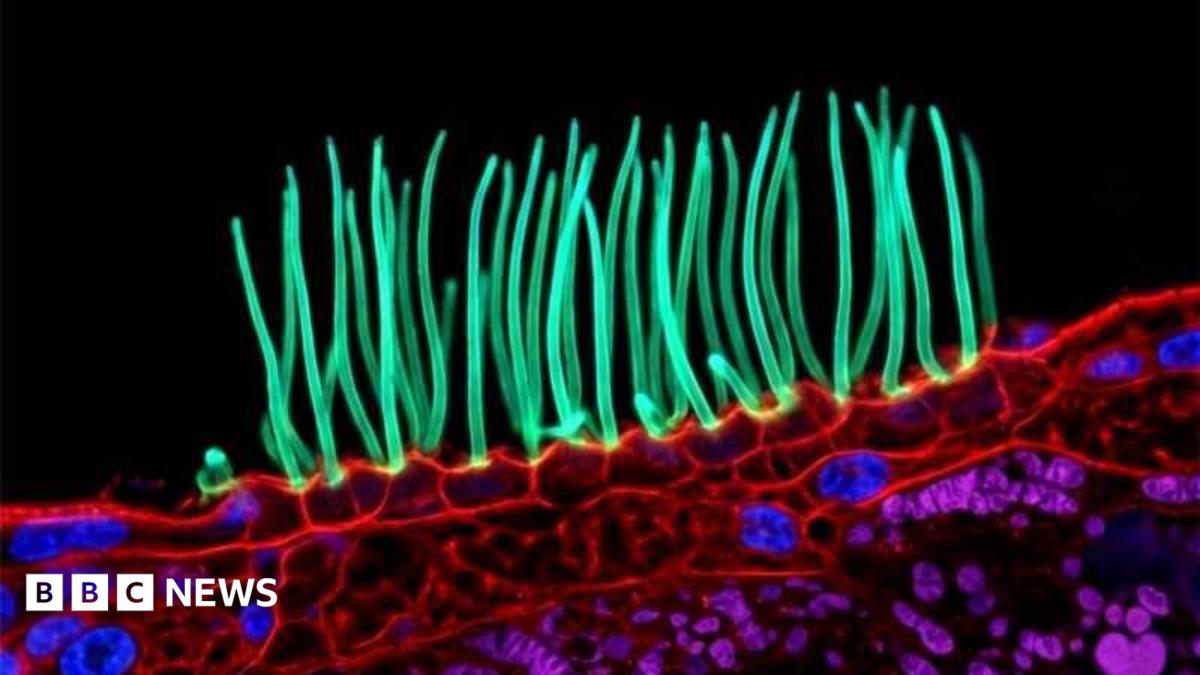

The prestigious Nikon Small World in Motion competition is currently facing scrutiny after critics raised concerns that the winning entry may have utilized artificial intelligence (AI) in its creation. Held annually for 15 years, this contest showcases remarkable photographs and videos captured through advanced microscopy.
This year’s top accolade went to a video created by Dr. Ning Xu, a researcher affiliated with Tsinghua University in China. The video purportedly depicts minute, hair-like structures known as cilia in the airways of a child suffering from a rare disease. However, the validity of this entry is now under re-evaluation.
Although Dr. Xu did not respond to the BBC’s inquiries, he has publicly defended his submission, asserting that he complied with the contest rules. He commented on a LinkedIn post by Nikon, acknowledging the use of AI in image processing but maintaining that it was not involved in generating the actual experimental footage of the cilia or their movements.
The video features artificially enhanced colors, which is a common practice in microscopy. Dr. Xu clarified that these enhancements are typically achieved through manual staining and dyeing of the samples. However, he conceded that AI played a role in “distinguishing and visualizing features in the reconstructed grayscale images.”
Critics, including fellow scientists, have flagged issues with the video. They claim that inconsistencies in shapes and movements raise questions about its authenticity. Observations have been made that some structures in the footage appear to “pop in and out of existence,” leading to skepticism regarding the portrayal of cilia size and behavior.
Edward Phelps, an associate professor at Florida University, highlighted these anomalies in a comment on Nikon’s social media platform, pointing out odd appearances of cilia. Similarly, Ian Donovan, a PhD student at UT Southwestern Medical Center, noted a distinctive watermark on the source image that suggests it may have been generated using AI technology.
Furthermore, two former judges of the competition have voiced their doubts about the legitimacy of the video, intensifying the ongoing debate about the balance between technology and authenticity in scientific representation.
Editor’s Take
This situation underscores the growing intersection of AI and scientific inquiry, prompting vital discussions regarding authenticity in data representation. As AI tools become more integrated into research methodologies, establishing clear guidelines will be paramount. This case may influence how future competitions establish criteria around the use of AI, impacting researchers, businesses, and technological innovation.
Source: www.bbc.co.uk