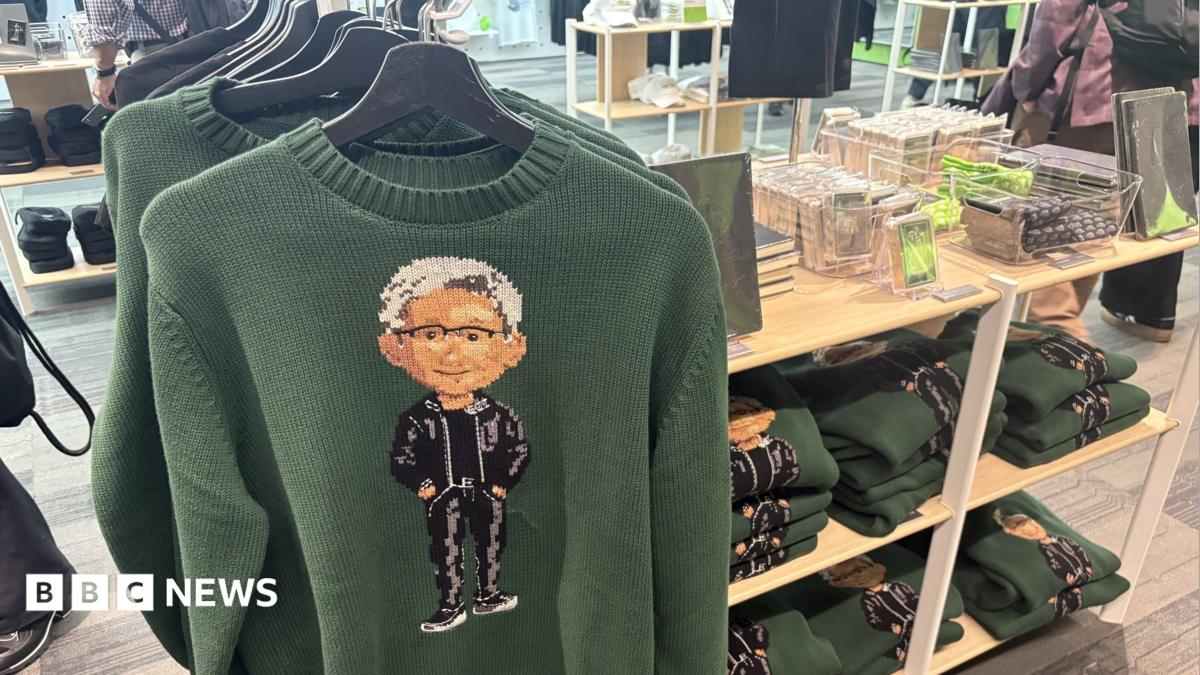

Natalie Fratto finds a unique connection with her dark green sweater, a notable piece from Nvidia, a leading player in the microchip industry. To her, wearing this $178 (£132) wool garment is as meaningful as donning a sports team jersey.
Emblazoned on the front is a whimsical illustration of Jensen Huang, Nvidia’s esteemed CEO. Although Fratto is not employed by the company, her admiration for Nvidia is palpable.
“I have a New Zealand All Blacks rugby jersey, and I see my Jensen sweater in a similar light,” explains Fratto, who operates a tech startup in New York. She describes the garment as a representation of a team and an ethos that inspires her, showcasing it proudly in her social media videos.
Under Huang’s guidance, Nvidia has emerged at the forefront of the tech sector, leveraging the AI boom to become one of the world’s leading corporations. While the company sells millions of chips annually, its apparel line is notably more limited.
Nvidia’s clothing—a collection that includes t-shirts, hoodies, and hats—often becomes available during pop-up events at conferences or through exclusive online “drops” that vanish quickly due to high demand.
While it might seem unconventional for a tech firm to dabble in fashion, Nvidia is not alone. Companies like OpenAI, the creator of ChatGPT, primarily distribute branded merchandise to employees but occasionally open sales to the public for limited periods. In a similar vein, Anthropic, developer of the Claude chatbot, recently hosted a pop-up coffee shop in Manhattan, where they distributed free baseball caps to patrons.
According to Professor Hazel Clark from Parsons School of Design, this strategy mirrors techniques commonly used in the fashion industry. “Restricting availability is a well-known tactic to enhance desirability,” she notes.
But why are these tech companies venturing into the apparel market at all? Given their substantial revenues, the necessity for added income is questionable.
Though Nvidia, OpenAI, and Anthropic refrained from commenting, it appears that brand promotion and reputation management are significant motivators behind this trend.
For instance, Palantir Technologies—a firm that has faced scrutiny for its partnerships with military and police forces—has rebranded itself as a “lifestyle brand” since launching its own apparel line last year.
Eliano Younes, head of strategic engagement at Palantir, explains, “A lifestyle brand isn’t solely about products; it’s about what you represent and how people identify with it. The success of our store, along with community enthusiasm, indicates this connection.”
Younes also mentions that “investors, customers, employees, and everyday people” from over 60 countries have shown interest in Palantir’s merchandise, which includes items like cotton jackets.
Editor’s Take
The foray of tech companies into fashion signifies a merging of industries that could reshape brand interactions. As these companies seek to bolster their reputations and create communities around their identities, users may find new avenues for engagement. This trend highlights the importance of brand loyalty in a competitive market and suggests potential implications for future AI developments.
Source: www.bbc.co.uk