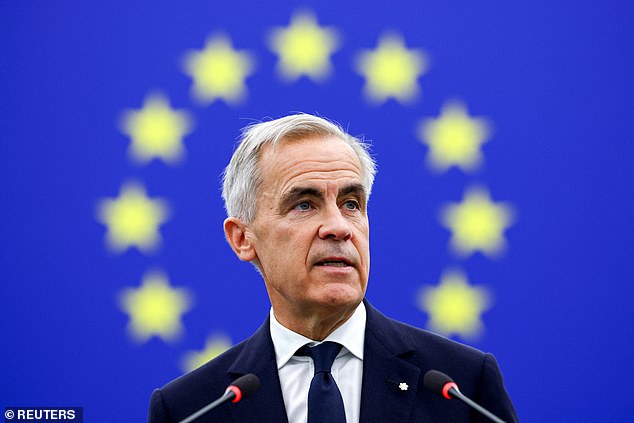

Mark Carney, Canada’s Prime Minister, recently criticized Donald Trump during his address to European lawmakers, expressing support for Canada’s potential status as an associate member of the European Union (EU). This remark came in response to Trump’s warning that Canada’s advancement toward this status could be seen as a “hostile act.”
Carney’s comments were made as he spoke to the European Parliament, following Ursula von der Leyen, the President of the European Commission, who had proposed detailing this new association. This development emerges amid ongoing tensions as Trump’s comments and tariffs drive Canada closer to the EU.
Emphasizing the shared values and strengths of Canada and Europe, Carney stated, “We are not fair-weather allies. We do not pursue zero-sum deals,” urging a united front between the two regions. He added, “Canada and Europe are each strong. Europe and Canada are stronger together.”
In a separate event in Charlotte, North Carolina, Trump reacted to the proposal, threatening to impose additional tariffs on Europe depending on the intentions behind the EU’s discussions with Canada. He remarked that if those intentions are deemed negative, the U.S. would respond accordingly with heavy tariffs.
Trump dismissed the idea of Canadian membership with the EU as “laughable,” criticizing Canada as a “terrible trade partner.” Historically, Canada’s economy has been closely tied to the U.S., but ongoing tensions from Trump’s trade policies have prompted a reevaluation of these ties. Carney emphasized that Ottawa intends to establish a more independent relationship with Europe.
Von der Leyen’s proposal would require new treaty provisions for Canada to attain associate membership—a status currently non-existent within the EU framework. She expressed a desire to elevate the relationship to its highest potential level, aiming to forge a new “Alliance for the Future” that encapsulates both economic security and shared prosperity.
Carney is set to host a Canada-EU summit in Montreal on October 29-30, where detailed discussions about the proposed relationship will take place. Currently, about 70% of Canada’s exports are directed to the United States, heightening their vulnerability to U.S. tariffs.
In contrast to Ottawa’s backlash against U.S. trade demands, Europe has opted for a different strategy by shelving retaliation, accepting tariffs of up to 15% on most EU exports to the U.S. Carney has consistently urged nations to resist economic coercion, advocating that countries negotiating in isolation with a stronger power often find themselves at a disadvantage.
In January, at the World Economic Forum in Davos, Carney warned that countries negotiating unilaterally with dominant forces tend to “negotiate from weakness.” Following his latest remarks, tensions between him and Trump may escalate further.
Jonathan Wilkinson, Canada’s ambassador-designate to the EU, clarified that while Canada is not seeking full EU membership—owing to concerns about surrendering sovereignty—it aims to strengthen ties with Europe while maintaining independence.
The specifics of what this new associate membership could entail remain to be established. This year, Canada has already moved closer to European integration by becoming the first non-European nation to join the EU’s €150 billion ($173 billion) defense procurement initiative, allowing Canadian firms access to lucrative contracts as Europe ramps up defense spending. Furthermore, discussions are ongoing regarding cooperation in areas like energy, critical minerals, artificial intelligence, and digital trade.
This is a breaking news story. More to follow.
Editor’s Take
This development signifies a pivotal moment in international relations for Canada and its pursuit of a more balanced global position. As tensions with the U.S. continue, the potential for Canada to solidify ties with the EU could reshape its economic landscape, offering new opportunities and collaborations. For businesses and developers, this transition may lead to enhanced market access and innovation, particularly in technology and trade.
Source: www.dailymail.com