England Experiences Wettest Week in Two Years Amid Storms, Yet South Remains in Drought

This week marked the wettest period in England in two years, with Storms Austen and Boelo bringing substantial rainfall across the country. However, certain regions in the south are still grappling with drought conditions.
In the week leading up to October 27, an average of 55mm of rain fell nationwide, with reports of as much as 76mm in the north-west and 87mm in the south-west.
The consequences of Storm Boelo, just days following Storm Austen, were severe. Major travel disruptions occurred, including train cancellations and flight delays, while floods forced several businesses to close.
The Environment Agency (EA) has indicated that this week has surpassed all others since October 24, which saw widespread disruptions from Storm Ashley.
While river levels surged at nearly all monitored locations, the Dart River at Austins Bridge in Devon was recorded as ‘extremely high.’
Despite the heavy rainfall affecting mainly the north, parts of southern England continue to experience drought after enduring one of the hottest summers in decades.
Recently, a ‘severe drought’ classification was issued for regions including Cornwall, Devon, Dorset, Somerset, East Sussex, and West Sussex, with some areas remaining alarmingly dry.
Water suppliers have been urged to enhance drought planning due to concerns about water availability, as millions face a hosepipe ban.

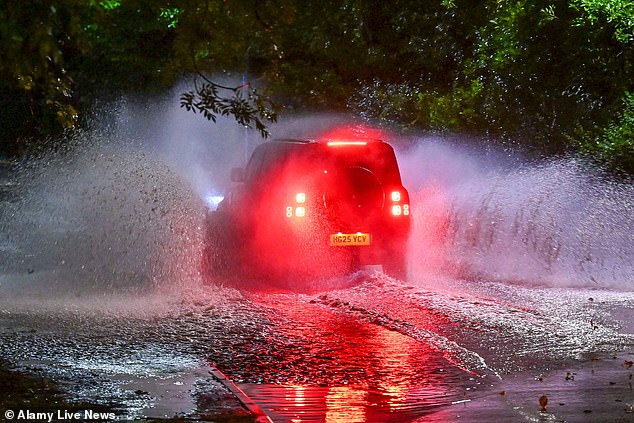
A car attempts to drive through a flooded lane in Poole, Dorset.
Storage levels in Devon and Cornwall have fallen dramatically to just 31%, with certain reservoirs critically low.
Drone images taken in Wimbleball, located in Exmoor, revealed striking views of formerly water-filled areas left completely dry following an extreme summer with temperatures exceeding 37°C.
While some regions remained dry, others faced intense weather, including wind gusts reaching up to 85mph.
Tragically, a 60-year-old man lost his life when a tree fell on him in Dumfries, and another fatality was reported when a man in his twenties was trapped by a falling tree in Mill Hill, north London. The man in Scotland was notable gardener Richard Baines, remembered fondly by colleagues for his passion.
A woman named Sal Galloway also sadly died after being swept into the sea while walking her dog on the Isle of Wight. An extensive emergency response involving police and coastguard teams was initiated but could not save her.
Footage from Dalmarnock, Glasgow, showed significant flooding, causing numerous business closures, while Largs in Ayrshire also experienced severe inundation.

Waves crashing on Brighton beach.
In Scotland, a shop owner sobbed as she described her establishment being wrecked by floodwaters. Toni Dawson, owner of Geraldo’s ice cream and gift shop, expressed her distress, noting how quickly the situation escalated, necessitating urgent damage control.
Recent data from the Energy Networks Association (ENA) revealed that over 161,400 homes experienced power outages this weekend, with more than 800,000 affected during both storms.
Looking ahead, Storm Chloe has been assigned as the next name for the season, waiting for conditions severe enough to warrant an amber or red weather warning from the Met Office.
According to the Met Office, the current wave of storm activity is primarily driven by a notably active jet stream.
Editor’s Take
This extreme weather highlights the growing urgency of climate change and its impact on regions previously not considered vulnerable to serious flooding. Businesses and communities must adapt to these changes, especially as unpredictable weather events continue to challenge existing infrastructure and preparedness strategies.
Source: www.dailymail.com