
The use of Google products has always been accompanied by privacy concerns, especially given the vast amount of personal data that the tech giant collects. Historically, Google has assured users that sensitive information from services like Gmail, Drive, and Photos would not be utilized for ad targeting. However, a recent alteration to the company’s privacy policy raises questions about the validity of this assurance.
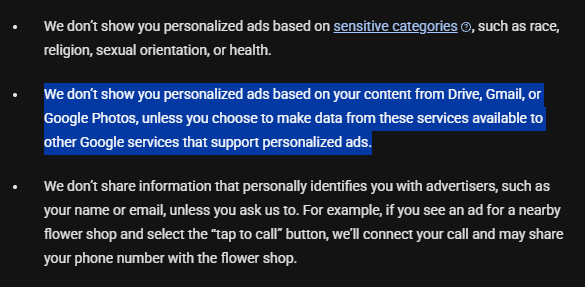
On October 16, Google updated its privacy policy, which was first reported by Android Authority. Previously, the policy explicitly stated, “We don’t show you personalized ads based on your content from Drive, Gmail, or Photos.” This statement has now been revised, prompting concerns about how user data might be leveraged in the future.
Credit: Google
Updated language on when your sensitive data might inform ads.
Credit: Google
This ambiguity in the policy suggests a potential shift towards using data from applications such as Gmail and Photos for advertising when it is shared across other Google services. This is particularly concerning given the recent launch of Personal Intelligence in early 2026, a feature designed to enhance interactions with AI products by allowing users to share data from multiple apps.
Personal Intelligence links user data to applications like the Gemini app and search functionalities employing AI capabilities. Although the Gemini app currently does not feature ads, users may encounter sponsored content within AI-based search tools. Changes to Google’s privacy policy suggest that data shared through Personal Intelligence could be used for personalizing advertisements.
Google asserts that this clarification does not imply that ads will be “based directly” on individual user data. The company’s statement reads, “Connecting your apps is entirely opt-in. Ads will continue to be relevant to things like your query, the context of the response and your interests. Ads will not be based directly on your Gmail inbox or Photos library, and as always, sensitive information will not be used to tailor ads.”
However, this statement appears to indirectly confirm that data from Workspace and Photos may indeed inform advertising strategies. If users engage with AI functionalities while Personal Intelligence is active, insights gleaned from their data could affect the responses they receive, suggesting that their data may play a role in ad targeting via AI-driven searches.
Editor’s Take
This development is significant as it blurs the lines between user data privacy and targeted advertising. For users, this may raise concerns about how their personal information is utilized even if they opt in. Furthermore, businesses may need to reassess their ad strategies in light of these changes, while developers must navigate the complexities of integrating AI with evolving privacy standards.
Source: arstechnica.com