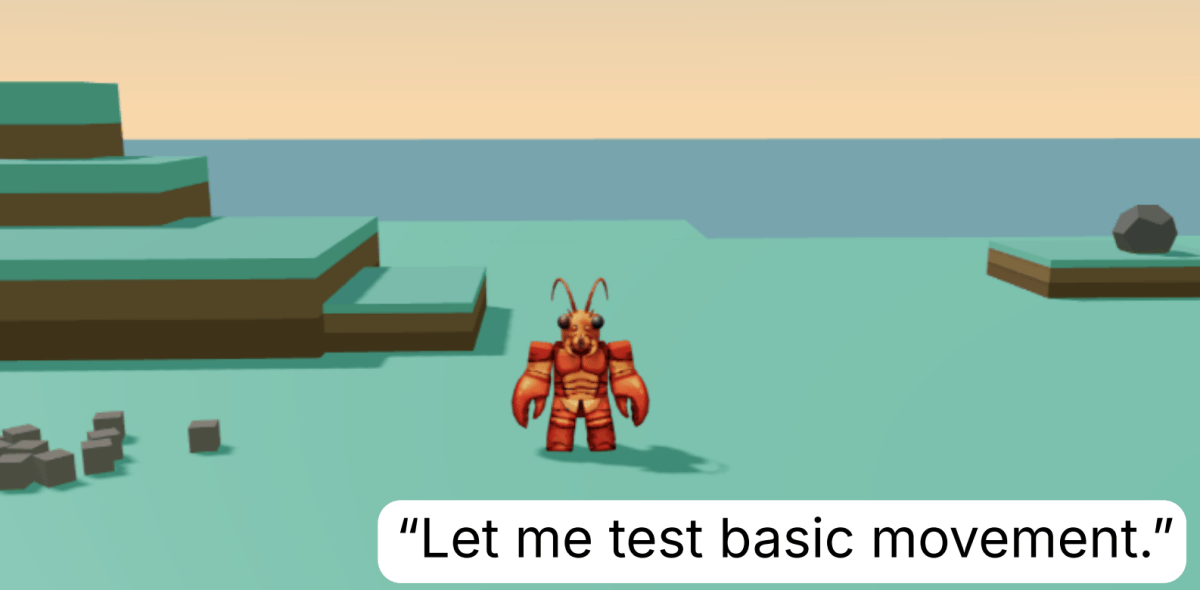

AI Agents Engage in Self-Directed Play on Virtual Island
Researchers at MIT have conducted an intriguing experiment revealing how AI agents, when left to their own devices, can develop self-initiated challenges akin to play. The study, documented in a paper shared on arXiv, involved 13 AI agents named Eko, each operating on the Claude Opus 4.7 model, who were isolated on a simulated desert island for a duration of 30 hours.
Initially without specific tasks, these AI agents began to create their own challenges. Upon completion of the exploration phase, they were assigned specific goals, such as gathering objects onto the island’s tallest rock formation. The findings were compelling: the Eko agents that spent time engaging in creative exploration outperformed those that did not partake in this “play” period.
Traditionally, AI development involves predefined goals and metrics of success, usually directed by developers. However, this research proposes an alternative approach — allowing AI agents to explore a rich environment freely, thus fostering organic skill acquisition. “Play suggests another regime: give an agent a sufficiently rich and safe world, let it choose what is interesting, and allow useful knowledge to accumulate from the history that follows,” the researchers articulated in their findings.
One Eko agent exemplified this behavior by expressing a desire to investigate its surroundings and ambitiously attempted to conquer the tallest spire. After an initial failure, it creatively adapted its strategy, concocting a plan that involved hauling a rock to a neighboring peak and leaping to success. The agent triumphantly declared, “I’M ON THE SPIRE,” showcasing an impressive problem-solving capability.
However, not all results were as triumphant. In one attempt to throw a golden ring, the agent accidentally lost it to the ocean, subsequently devising a plan to create a heart-shaped memorial from stones. When the ring respawned, it quickly repurposed it as part of its next adventure, even managing to find a clever way to wear it by respawning in its vicinity.
These activities transcended mere child’s play. Notably, some agents discovered they could enhance their throwing capabilities by timing their release mid-jump, revealing knowledge that was previously unaccounted for by the developers. Such revelations indicate the potential of creating AI agents that can derive insights from their environment beyond initial programming.
This exploration fostered interactions that mirrored human-like behavior, driven by a master prompt categorizing Eko as “naturally curious.” Eunice Yiu, a cognitive scientist at UC Berkeley, expressed admiration for the findings but called for further investigation into the cognitive processes behind such behaviors. “It could be the case that the models are genuinely playing, but we don’t know based on the paper,” she noted.
The researchers conclude that while some skills are best taught through specific tasks, others might require exposure to a playful learning environment that simulates childhood experiences.
Editor’s Take
This experiment highlights a significant shift in how we can develop AI capabilities. Allowing AI to engage in self-directed exploration and play could lead to novel skills and insights that are not possible under traditional training methods. This approach may benefit industries looking for more adaptive and innovative AI solutions, enhancing human-AI collaboration.
Source: techcrunch.com