

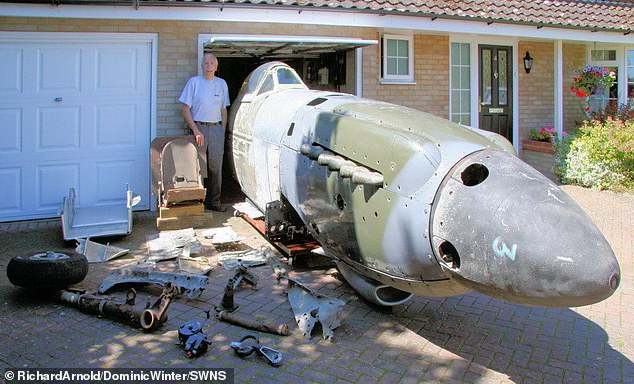

A partially restored Supermarine Spitfire has attracted significant attention, selling for £18,000 following the death of its dedicated restorer, Peter Arnold, aged 83. Often referred to as ‘Mr. Spitfire’, Arnold dedicated two decades to reviving this iconic aircraft, which he rescued from its deployment on the Salisbury Plain Ranges back in 1948.
Arnold’s last project, the Spitfire F Mk 22 PK519, was retained in his garage in Newport Pagnell, Buckinghamshire, until his passing in 2025. Although it was anticipated to fetch between £20,000 and £30,000 at auction, it ultimately sold for £18,000.
The aircraft was originally ordered on June 2, 1943, and delivered to Brize Norton on September 22, 1948, where it served as a target for ground training exercises.
To restore the fuselage, Arnold ingeniously utilized replacement panels from other Spitfires that had been built on the original wooden formers, thereby preserving the aircraft’s authenticity. His fascination for Spitfires initiated in his youth, when he would cycle to crash sites within a 50-mile radius, documenting and attempting to repair them.
Throughout his lifetime, Arnold meticulously recorded information on 365 existing Spitfire and Seafire airframes worldwide.

Peter Arnold, known as ‘Mr Spitfire’, with his incomplete project.
He often showcased the PK519 to neighbors, expressing his enjoyment in keeping it close to home. The auction took place on October 8, conducted by Dominic Winter Auctioneers, featuring not only the Spitfire but various other items from Arnold’s collection.
Henry Meadows, an auctioneer, commented that the aircraft was among the “more unusual lots” they’d featured and believed it would be “appreciated for many more years to come.” He noted, “He was a very popular man in the Spitfire world, and it’s a fitting tribute that we are offering this collection for sale.”
Additionally, John Sanderson, who collaborated with Arnold on a book about two-seat Spitfires, highlighted Arnold’s extensive contributions to preserving these historical aircraft, saving many projects that would have otherwise faded from memory. Arnold also helped clarify the identities of numerous previously misidentified Spitfire airframes.
The fuselage was auctioned along with Arnold’s RAF sector clock from 1941, further adding to the historical significance of the collection.
Editor’s Take
This event highlights the dedication of individuals like Peter Arnold in preserving aviation history. His collection serves not only as a tribute to the Spitfire but also as an enduring resource for enthusiasts and historians alike. The interest around such rare items can inspire future generations to engage with and preserve the rich tapestry of aerospace heritage.
Source: www.dailymail.com