
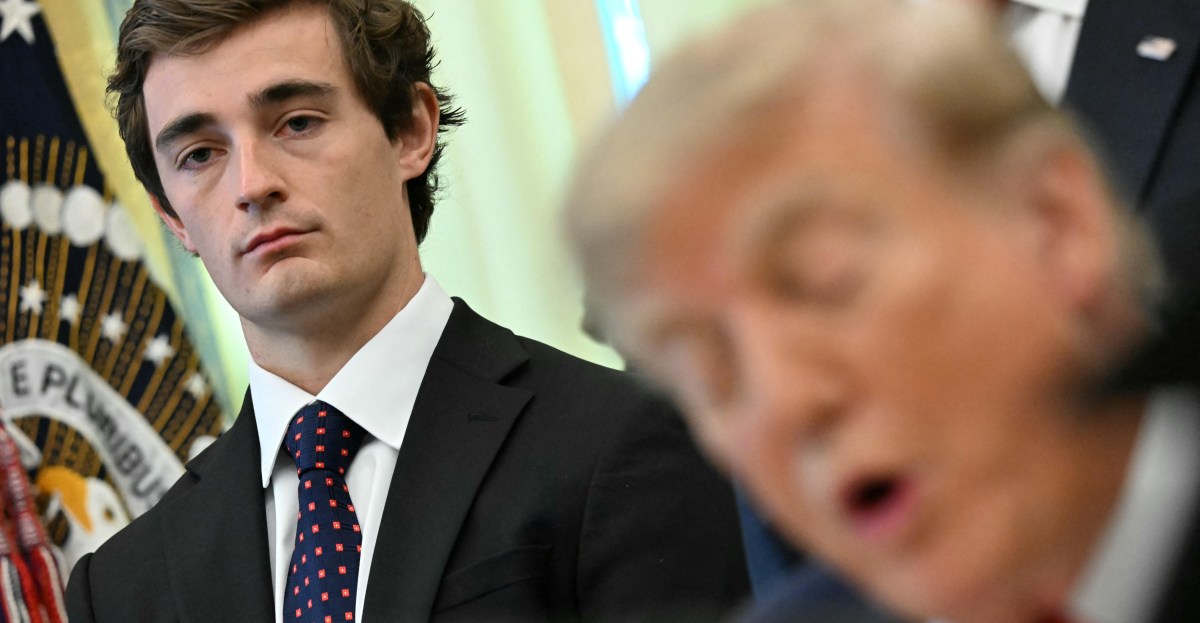

Donald Trump and Vice President JD Vance announced a significant initiative on Tuesday, unveiling a $25 million bounty program encouraging citizens to report fraudulent activities, alongside a direct payment of $10,000 to right-wing YouTuber Nick Shirley.
In December 2025, Shirley garnered attention for releasing a viral video that accused daycare centers operated by the local Somali community in Minnesota of fraud. His approach included lingering in parking lots and attempting to gain access to childcare facilities, interpreting refusals as proof of malfeasance. The video’s widespread reach prompted a substantial governmental response, with federal immigration agents mobilizing in the Minneapolis area and the Trump administration freezing federal childcare funding in Minnesota.
Shirley’s tactics have since spread to other states, where he has visited grocery stores and hospice centers uninvited, seeking evidence of fraudulent behavior. The administration has lauded him, as he has become a recognizable figure within the MAGA-aligned influencer sphere. He has contributed to the rise of a controversial form of so-called independent journalism, in which content creators confront individuals or businesses suspected of wrongdoing, often resulting in harassment or immigration enforcement.
The Trump administration further revealed the launch of the Fraud Whistleblower Incentive Program (WHIP), offering $25 million to anyone who reports suspected fraud. The program emphasizes fraud in areas including hospice care, home healthcare, and daycare services. A dedicated chatbot has been developed to facilitate the reporting process, guiding users on how to provide detailed accounts of their observations.
According to reports, individuals who report fraud could earn up to $30,000 if their tip leads to a conviction or notable federal action. However, Trump contradicted this figure during his announcement, indicating that the commission could be as high as 1% of the fraudulent amount discovered. For instance, a $1 billion fraud would yield a $10 million reward based on this percentage.
While the arrangement involving Shirley and the funding mechanisms was not immediately clarified by the White House, controversy surrounds Shirley’s methods, particularly in Minnesota. Critics point out that a significant number of fraud investigations were already in progress prior to his intervention. His assertion that he was unveiling fraud in the community has drawn backlash, especially since subsequent investigations by state officials found that many of the centers he targeted were operationally sound.
Editor’s Take
This development raises critical questions about the intersection of misinformation and government policy. Encouraging citizen reporting of fraud could lead to increased scrutiny in sensitive sectors, potentially impacting innocent individuals and legitimate businesses. The implications for social media influencers and their role in shaping public opinion and government actions are profound, emphasizing a need for responsible content creation in a rapidly evolving digital landscape.
Source: www.theverge.com