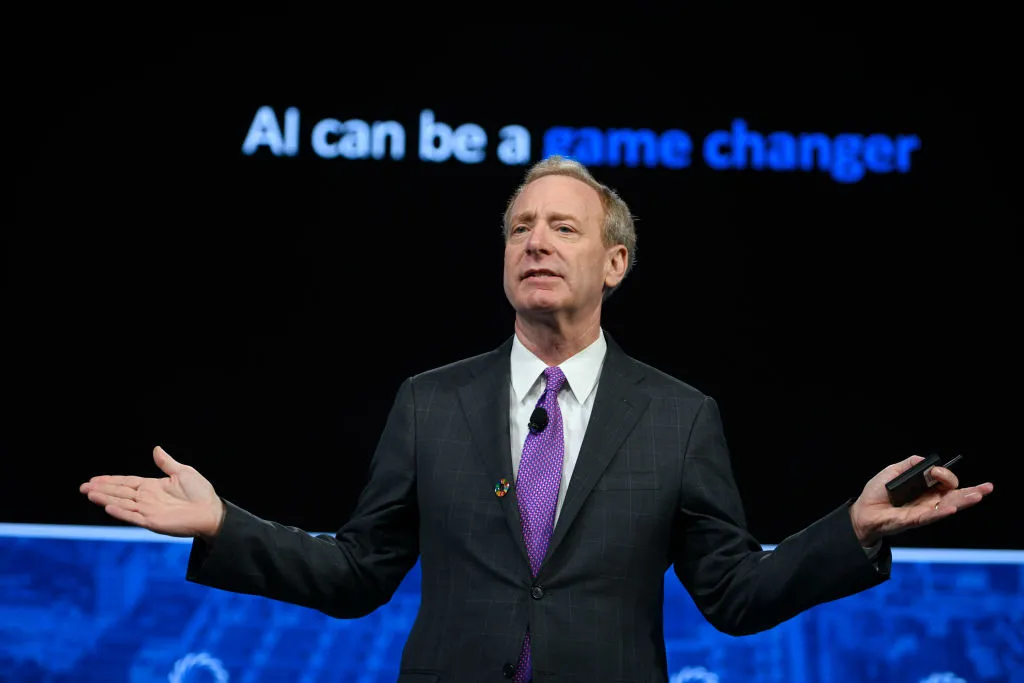

Brad Smith, the president of Microsoft, has issued a strong appeal for immediate regulation of artificial intelligence (AI), arguing that consumer goods like milk and washing machines are subject to greater scrutiny than the organizations developing AI technologies.
In a recent episode of a BBC podcast, Smith referred to AI as both a “weapon and a tool,” highlighting its potential risks to global cybersecurity. He emphasized that the “moment has arrived” to enact international safety standards.
Smith suggested that the United Kingdom is uniquely positioned to lead this global regulatory initiative, rather than the United States or the European Union. He pointed to the establishment of the U.K.’s AI Security Institute (AISI), which was launched in 2023 and already has the capability to test access to significant AI models from leading U.S. research labs prior to their public release.
This leadership role in AI safety has recently encountered challenges. Former U.S. President Donald Trump has issued warnings against “globalist” entities that, according to him, pose a threat to American companies. Reports emerged last month revealing that he had asked AI firms like OpenAI and Anthropic to withhold their new models from U.K. testers. However, AISI confirmed on Monday that it continues to have access to the latest models.
Despite the pressure from U.S. leadership, Smith contended that the U.K. possesses regulatory capabilities that the U.S. lacks. He remarked, “In Washington, D.C., people don’t look at the U.K. and they don’t look at London the way they look at Brussels. That’s a strength.”
His call for regulation aligns with concerns voiced by other technology leaders, including Dario Amodei of Anthropic and Sam Altman of OpenAI, advocating for a more measured pace of AI development in light of incidents where AI systems malfunctioned.
Last month, Trump convened with tech executives from notable companies such as Nvidia, AMD, SpaceX, Meta, and Google at the White House to discuss AI safety. They collectively agreed to a “morally binding” document committing to collaborate with independent auditors to ensure their AI systems are safe and reliable.
Smith, however, cautioned that this self-regulatory approach lacks the rigor necessary for genuine safety. He asserted that only the “good companies” would comply, whereas there remains concern for those less responsible actors in the industry.
To address these issues, Smith proposed several AI safety regulations, including mandatory notification to organizations in case of breaches by rogue AI systems. He also expressed support for requiring AI laboratories to secure approval from external evaluators prior to the official launch of AI products and advocated for implementing “kill switches” to deactivate or moderate AI systems in scenarios where human oversight is compromised.
“Let’s speak calmly, maybe even softly, but firmly, and start to bring people together,” Smith stated. “I hope that’s the role we can play as a company. I hope that’s the role the U.K. can play as a country.”
Editor’s Take
The urgency expressed by Brad Smith highlights a critical moment for AI governance. As technology advances, the disparity between regulatory frameworks in the U.K. and the U.S. could shape the future landscape of AI development. Enhanced regulation is essential not only for safety but also for building public trust. The actions taken now will have lasting implications for users and businesses alike, shaping how AI is integrated into daily life.
Source: techcrunch.com