
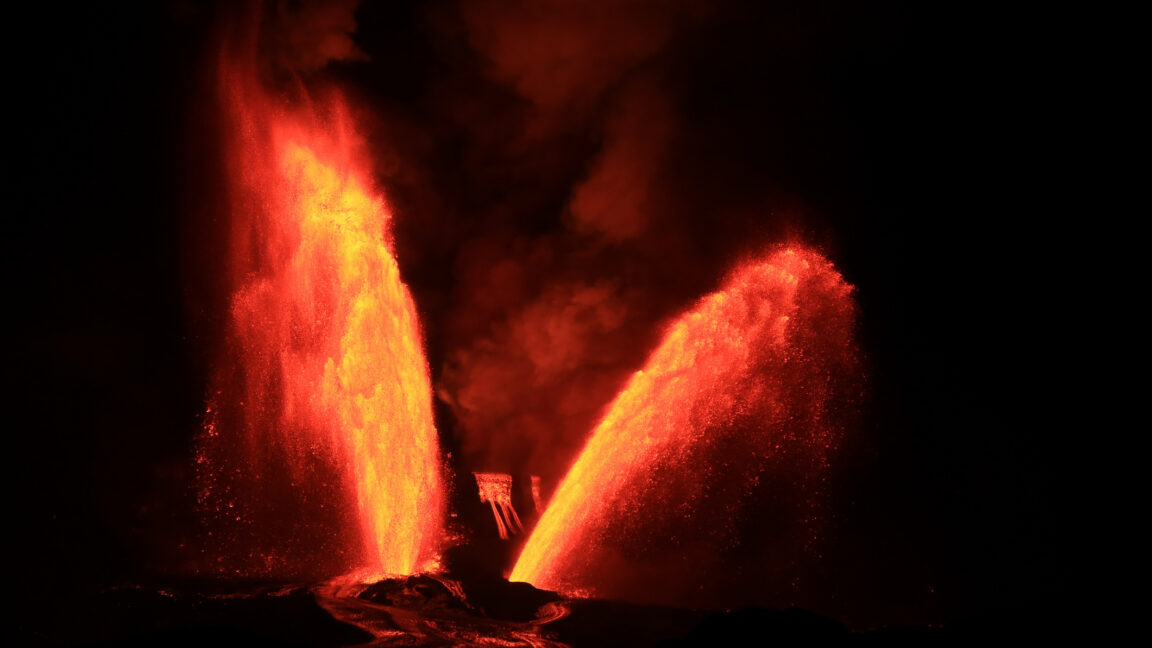

Volcanic activity often conjures images of slow-moving lava streams, allowing onlookers to escape to safety. However, certain regions, such as Mount Etna, Hawaii, and Iceland, witness spectacular lava fountains that can soar hundreds of meters into the sky. Understanding the mechanisms behind these dramatic eruptions remains a scientific mystery.
A recent series of eruptions at the Kilauea volcano has provided researchers with an invaluable opportunity to document these lava fountains like never before. In a new study published in Science, scientists from the US Geological Survey present their insights into the nature of these spectacular displays and what might be driving them.
A Legacy of Eruption
While there are three significant areas of volcanic activity that produce lava fountains, Kilauea has had a relatively modest number of fountaining events—just three since 1823. Despite being the youngest and most active volcano in Hawaii, Kilauea’s limited fountaining activity has fostered extensive scientific research. Geologists have unraveled much of the volcano’s intricate structure, identifying residual lava reservoirs located within several kilometers of the surface. To further this work, 35 specialized monitoring stations have been established around the volcano, employing various technologies such as seismic, infrasound, geodetic, gas analysis, and both visual and thermal imaging.
In the wake of a major eruption in 2018, which significantly depleted one of Kilauea’s underground lava reservoirs, researchers observed signs of a gradual refill. By 2019, this refill process accelerated markedly, with the local peak inflating at a staggering rate of over 22 centimeters annually. Notably, this rate surged to an impressive 57 centimeters per year by 2023, extending towards an adjacent caldera.
Editor’s Take
This recent study sheds light on the dynamics of volcanic eruptions, particularly at Kilauea, which has implications for disaster preparedness and public safety. Understanding the patterns of these lava fountains can help scientists predict future eruptions more accurately, potentially safeguarding lives and infrastructure in affected regions. Moreover, this research enhances our comprehension of geothermal processes, which could inspire innovative applications in energy generation and environmental management.
Source: arstechnica.com