

Houthis Strike Passenger Jet at Riyadh Airport Amid Rising Attacks on Saudi Arabia

The Houthis have launched an assault on a passenger aircraft at Riyadh International Airport, signaling a troubling escalation in their ongoing offensive against Saudi Arabia. This attack is part of a wider campaign by the Iran-affiliated group aimed at crippling the kingdom’s air traffic and oil infrastructure.
On Thursday, the Houthis escalated their strikes, with a notable focus on aviation and energy facilities, resulting in the deaths of three individuals and damage to an aircraft earlier this week. They claimed responsibility for targeting Riyadh airport and warned employees to remain clear of various energy installations, predicting more strikes.
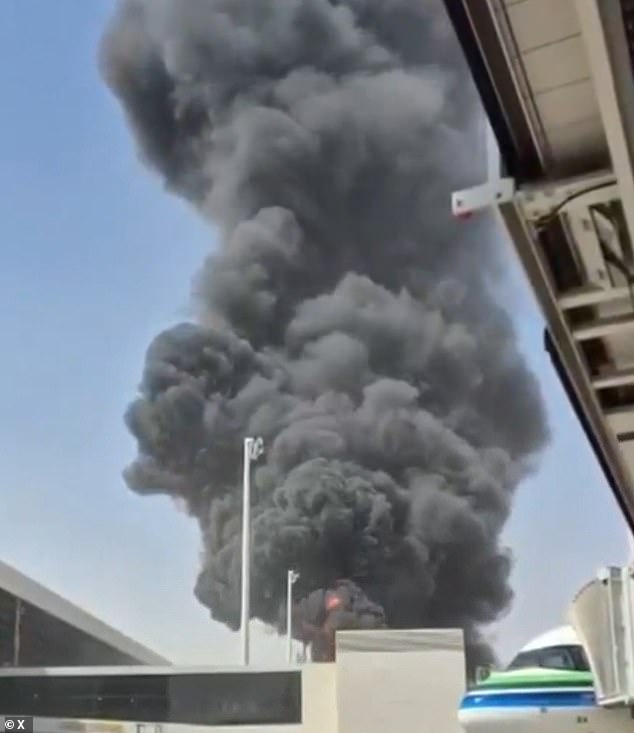
Shrapnel, either from a missile interception or another projectile, severely damaged a plane owned by Saudia Airlines, which was on the tarmac and caught fire during the incident. Luckily, no passengers were reported to be on the aircraft, but authorities could not confirm the absence of injuries resulting from the attack.
Eyewitness accounts report thick smoke and flames billowing from the airport premises. Despite multiple requests for comments, Saudi Arabia’s government media office, civil aviation authority, and Saudia Airlines have yet to respond.
In light of the attacks, both Lufthansa and Air India announced the suspension of their flights to Riyadh.

A thick black column of smoke and flames were shown rising from Riyadh airport
Separately, Saudi officials reported that debris from an intercepted missile struck a kindergarten and a medical complex in Riyadh, further heightening concerns over civilian safety amid ongoing conflicts.
The Houthis argue that their actions are aimed at counters against Saudi Arabia’s backing of government forces in Yemen’s resurgent civil war. Saudi Arabia claims it supports Yemen’s internationally recognized government in an effort to reclaim territories lost to the Houthis.
This conflict has escalated beyond Yemen, drawing in various regional powers, as tensions morph into a broader proxy confrontation between the US and Iran. Countries like Syria are contemplating military involvement, potentially complicating the already precarious situation.
Saudi Arabia has been seeking support from allies, including Turkey and Pakistan, to assist in its military endeavors and to secure the southern approach to the strategically vital Red Sea.
With the urgency of the situation amplified following recent fatalities in strikes against both Riyadh and Abha airport, the Houthis have made Saudi airfields a primary target. The Saudi-led coalition disclosed that it had intercepted two ballistic missiles aimed at Riyadh and another aimed at Khamis Mushayt, a key airbase.
Data compiled by aviation analytics firm Cirium revealed that, by 3 PM GMT, nearly half of all departures from Riyadh airport had been canceled, with further cancellations anticipated across Saudi airports. Flight tracker FlightRadar24 also indicated considerable delays in arrivals and departures, prompting the airport to advise travelers to verify flight statuses.
This week marks a particularly critical moment, with Riyadh expected to host the WPC Energy Congress, a gathering of key energy sector stakeholders. Several multinational corporations located in the King Abdullah Financial District have instructed employees to work remotely in light of reported explosions.
Diplomatic circles noted that some officials received alerts, while several schools in the area communicated “shelter-in-place” directives to parents, though no official warnings were issued.
The conflict in Yemen, which had seen a pause due to a ceasefire in 2022, has reignited as the Houthis captured new stretches of the Red Sea coastline, impacting vital shipping lanes. Saudi-backed forces have begun counteroffensives, reclaiming territories near the strategic Bab el-Mandeb Strait.
Despite multiple battlefronts, the Houthis have expanded their control, tightening their grip on Taiz, Yemen’s third-largest city, as they continue to challenge the Saudi-supported coalition.
Reports indicate that both a US and a Syrian defense official are deliberating military options, including potential support for Saudi defense or offensive operations against the Houthis. In response to inquiries, a Syrian diplomat reiterated Syria’s support for Saudi Arabia but emphasized the need to focus on its domestic recovery efforts.
On the other hand, NATO-member Turkey has committed to providing mainly defensive support to Saudi Arabia, which includes military supplies and intelligence cooperation.
Editor’s Take
The recent escalation of Houthi attacks on Saudi Arabia is a significant development that could reshape regional security dynamics. As international stakeholders become increasingly involved and the conflict expands, users and businesses operating in the area should be aware of potential disruptions. This situation underlines the fragility of peace in a volatile region, with implications not just for the Middle East but also for global energy markets and technology sectors reliant on stability.
Source: www.dailymail.com