

Google has officially unveiled its latest advancement in artificial intelligence with the announcement of Gemini 4 Argon. Following its prior Gemini 3.5 Pro announcement earlier this summer, the tech giant had predominantly showcased smaller models, such as the Flash variants. Now, with Argon, Google asserts that it brings top-notch capabilities in software development, knowledge tasks, and cybersecurity, though external access to this model remains unavailable for the time being.
While the broader user community waits, Google engineers are already harnessing the power of Argon. It reportedly utilized “fleet-wide telemetry data” to achieve significant efficiencies, saving 300 terabytes of memory across its data centers. Furthermore, Argon has been instrumental in transitioning numerous C/C++ codebases to Rust, impacting core libraries like re2 and libgav1, along with over 800,000 lines in the Zircon kernel of Fuchsia OS.
To substantiate its claims, Google has released a comprehensive suite of benchmarks. On the DeepSWE v1.1 software engineering benchmark, Gemini 4 Argon achieved a score of 77.9%, surpassing notable competitors including GPT-6 Astra, Fable 5.1, and Opus 5.5. Additionally, Google highlights that its new model excels in long-term strategic tasks, as evidenced by its leading performance in the economic analysis Vals Index.
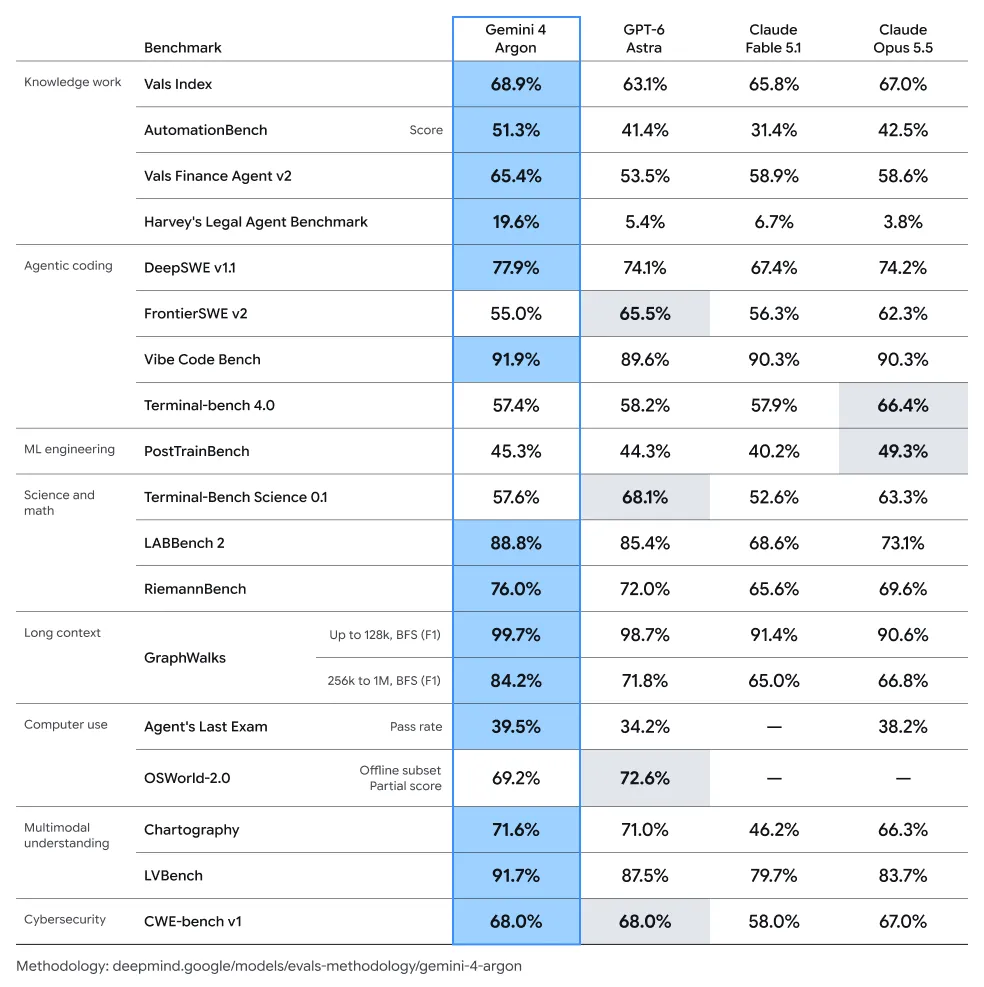
Currently, Google has not disclosed any pricing information for APIs pertaining to this model, as it is still undergoing limited testing. However, it has announced an enhanced capacity for Gemini 4 Argon, supporting a maximum output of 1 million tokens—a significant leap from the 64,000 tokens permitted in previous models. This increased limit is aimed at empowering users to tackle more complex tasks in one go.
Editor’s Take
The introduction of Gemini 4 Argon represents a significant advancement in AI capabilities, particularly in software engineering and cybersecurity. Its ability to handle complex tasks with a higher token limit could reshape how developers approach coding and system design. As more companies evaluate these powerful tools, the implications for productivity and innovation in the tech industry are profound.
Source: arstechnica.com