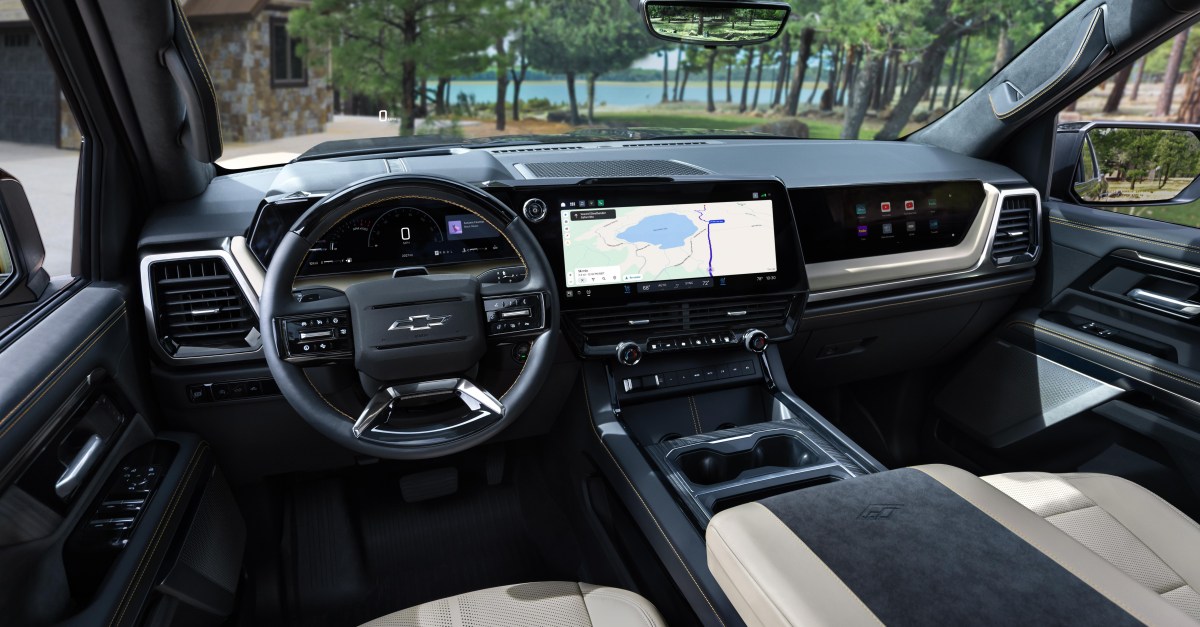

General Motors Enhances Software Experience in Trucks
General Motors (GM) is revamping the software interface for its popular trucks with the aim of minimizing distractions caused by excessive tapping and swiping to access frequently used features. The company is also introducing enhanced versions of Apple CarPlay and Android Auto that feature new picture-in-picture displays, marking a significant shift from GM’s previous stance against phone mirroring in its electric vehicles.
The upcoming software interface is set to launch later this year for the 2027 Chevrolet Silverado 1500 and the 2027 GMC Sierra 1500. This update will showcase an array of improvements, including sleek new graphics for its advanced driver-assist systems, smooth transitions between screens, and more intuitive layouts tailored to heavy-duty tasks such as towing and off-roading. All of this will be displayed on screens totaling over 60 inches in size across various segments of the trucks, thereby aiming to enhance the driving experience without overwhelming it.
For GM, the integration of larger displays does not equate to increased distractions. According to Colin McCormick, the group product manager for Google built-in systems at GM, the additional space provides an opportunity to present information more intelligently and to enlarge interactive elements for easier use, especially under challenging driving conditions.
McCormick emphasized, “The buttons can be larger and make it easier to do. Living in Michigan, the roads are terrible, so I’m trying to tap on a very small tap zone while hitting a bunch of potholes. These larger displays give you better functionality in that standpoint.”
While the new interface will still maintain physical buttons for essential functions like HVAC, it incorporates a new menu feature for adjusting airflow direction via a flyout system. GM recognizes that many customers prefer physical knobs and buttons, and thus is cautious about moving critical controls onto digital screens solely because more space is available. A notable exception includes the oil dipstick, which has transitioned to a virtual readout on the truck’s status screen, while the majority of physical controls remain intact.
Incorporating elements from smartphone design, GM’s latest trucks will feature a swipe-down notification system, providing rapid access to functionalities like switching connected devices and privacy controls. Notably, truck owners will be able to deactivate their vehicle’s microphone directly from this interface. The software is designed to differentiate between settings that are rarely adjusted and controls that may require frequent changes, enhancing user experience.
GM is addressing complaints regarding its existing interface, which has been perceived as inconsistent, with functions often occupying the entire display. The company aims to maintain continuity by allowing displays such as the media player to remain visible while additional panels slide in, thus cultivating a more contextual experience.
Recognizing that many truck owners frequently tow trailers, GM has redesigned the software to better support this functionality. Trailer-related information will be integrated into both the driver’s display and the home screen, with an innovative trailer-aware navigation system that adapts routes based on trailer specifications input by the owner. These dimensions can then be transferred between vehicles using the customer’s GM account.
The most noticeable improvements may be experienced by users of Apple CarPlay and Android Auto. GM has designed a picture-in-picture system that allows these applications to occupy a contextual card on the screen instead of taking over entirely. The new setup enables users to engage with their smartphone applications while still accessing GM’s native features, such as trailer information.
Despite its earlier decision in 2023 to phase out Apple CarPlay and Android Auto in its electric vehicles, GM is still committed to offering these functionalities in its gas-powered trucks and SUVs. The automotive giant previously faced backlash from customers over the initial ban but has strategically adjusted the design of CarPlay and Android Auto to coexist with its own infotainment systems.
McCormick noted, “I think we’re landing in a spot where… we don’t have a customer that has to decide, ‘Oh, I’m going to use projection, or, oh, I want to use the native system.’”
The new user interface is expected to be available only to new models, leaving existing owners with the previous version. This move prioritizes the introduction of the system in GM’s top-selling trucks, which account for approximately 900,000 units sold annually. As users interact with the updated interface, GM anticipates collecting valuable feedback to refine and improve the software through over-the-air updates.
Editor’s Take
This software evolution from GM represents a critical shift in enhancing driver experience and safety. By integrating larger screens and smarter layouts, GM aims to minimize distractions while maximizing functionality. The picture-in-picture feature for Apple CarPlay and Android Auto could redefine how users interact with apps on the road, making it easier to access essential vehicle controls. As the industry continues evolving, these developments could set a new standard for automotive technology.
Source: www.theverge.com