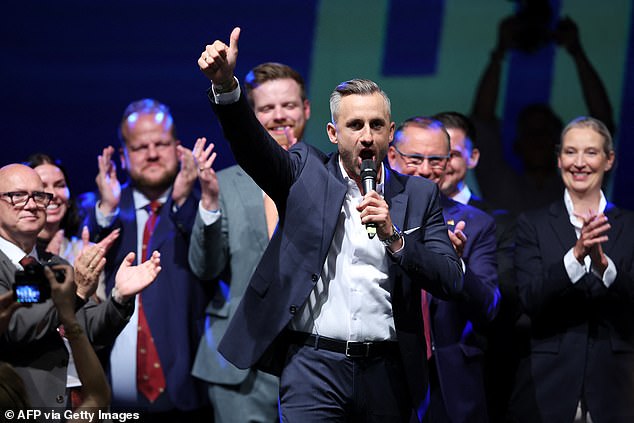
Elon Musk and European Right Leaders Celebrate AfD’s Historic Election Victory in Germany

Elon Musk and several notable far-right politicians in Europe have celebrated a landmark electoral win for the anti-immigrant AfD party in Germany. Musk took to social media to express his approval, posting “Well done!” following the party’s impressive performance in the eastern state of Saxony-Anhalt, where they outperformed traditional political rivals.
This election marks a significant moment for the hard-right AfD, placing them closer to a position of power at the state level for the first time since World War II. Analysts attribute the party’s rise to a combination of nostalgia for life in the former East Germany and persistent economic dissatisfaction that has lingered since reunification in the 1990s.
In a post-election interview, Alice Weidel, co-founder of the AfD, indicated that she anticipates current Chancellor Friedrich Merz, representing the center-right, will be replaced before Christmas. Italian Deputy Prime Minister Matteo Salvini, leader of the hard-right League party, also praised this victory, asserting, “another Europe is possible.”
Despite the win, the AfD did not secure the outright majority necessary to independently govern Saxony-Anhalt, garnering 43.8% of the vote compared to the conservative Christian Democratic Union (CDU) at 17.2%. The party aimed for an absolute majority in the state assembly to break through the mainstream parties’ collective refusal to collaborate with them.
Weidel stated, “We have received a very clear mandate to govern here,” while outlining a platform that prioritizes national interests, stringent border control measures, and deportation of non-compliant immigrants. However, the AfD’s ambition for power faces challenges, as rival parties have vowed to shun any coalitional government with the AfD due to its controversial history, including past uses of Nazi slogans.
French governmental officials shared similar concerns regarding the implications of this electoral outcome. Roland Lescure, France’s Finance Minister, labeled the situation a “very worrying signal,” emphasizing the global rise of populism that needs to be countered. His sentiments were echoed by Benjamin Haddad, France’s European Affairs Minister, who described the victory as a “grave moment for Europe.”
Saxony-Anhalt’s lead AfD candidate, Ulrich Siegmund, celebrated the results as historical, claiming the electorate has sent a clear message that current affairs are unsatisfactory. Voter turnout reached a striking 77.8%, with many casting their ballots for the AfD after abstaining five years prior.
The AfD’s proposed governmental policies have sparked controversy, including intentions to terminate state funding for integration initiatives and mandate labor for asylum-seekers. Additionally, they propose restricting educational access for minors without permanent residency. The party also aims for significant electoral gains in the next federal elections, setting a target of at least 40% of the vote.
Editor’s Take
This electoral outcome highlights a growing wave of populism and far-right sentiment in Europe, reflecting widespread discontent with mainstream political systems. For users and businesses, this could herald changes in immigration policies and economic strategies in Germany, impacting everything from workforce dynamics to digital innovation. Observers should monitor how this shift might influence policies across the EU.
Source: www.dailymail.com