
The journey to orbit has been a challenging one for the German company Isar Aerospace, marking a significant milestone in Europe’s burgeoning space sector. Despite a long-standing reputation for stability, the European space industry often struggles with innovation and agility, a dynamic that Isar aims to disrupt.
During a recent press briefing, Isar Aerospace’s CEO, Metzler, reflected on the company’s early days in 2018 when the concept of a ‘New Space’ industry was still in its infancy on the continent. “People doubted our vision and said it wouldn’t succeed. But persistence is ingrained in our culture,” he said. “We will keep pushing forward until we prove the skeptics wrong.”
After eight years of development, Isar has finally achieved its first successful orbital launch. This timeline aligns with that of other commercial rocket startups in the West. Throughout this period, the company has raised approximately $1 billion through multiple private funding rounds, growing its workforce to nearly 500 employees. This positions Isar as the most well-funded private launch company in Europe.
Metzler noted the importance of viewing progress through a broader lens; he stated, “Many tend to overestimate short-term capabilities while underestimating long-term potential. We have a dedicated team of engineers and technicians who dream big and challenge the odds.”

Credit: Isar Aerospace
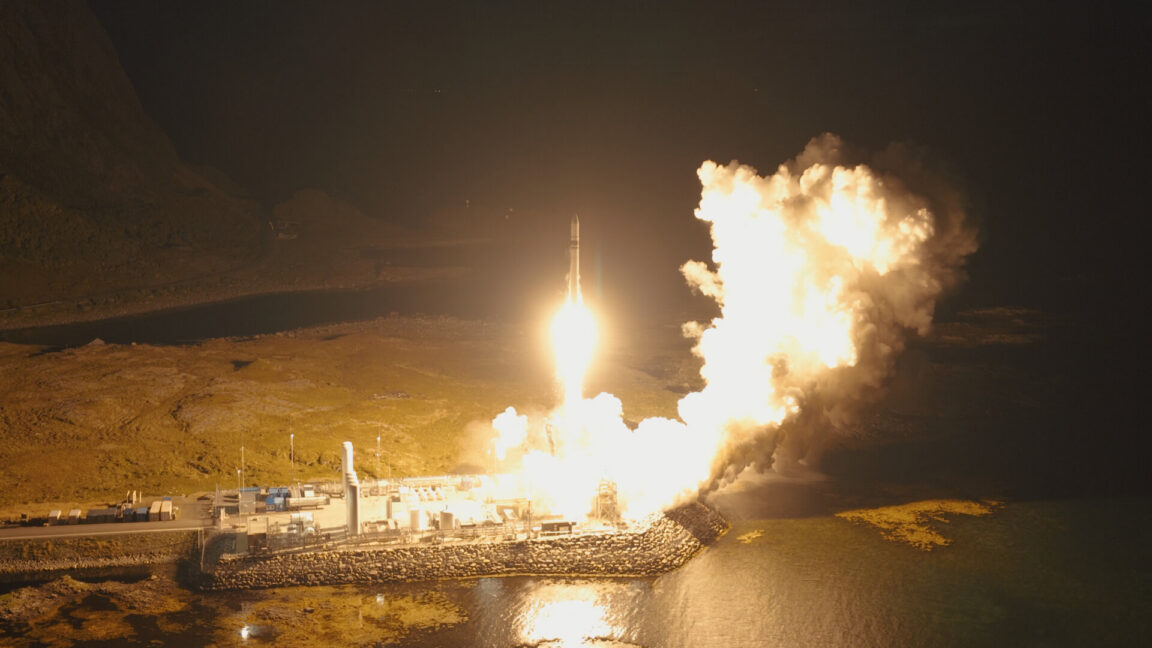
The Spectrum rocket streaks into the sky over Andøya Spaceport, Norway, on Saturday evening.
Credit: Isar Aerospace
Implications for the European Space Landscape
The successful launch by Isar is a positive development for the European Space Agency and other stakeholders in Europe’s space industry, who are increasingly seeking cost-effective solutions for satellite deployment. Traditional launch providers such as Arianespace and Avio have heavily relied on government subsidies, securing billions of euros to support their operations. Despite the reliability of their current offerings, including the Ariane 6 and Vega-C rockets, these companies face significant challenges in remaining competitive within a rapidly evolving market.
Editor’s Take
This landmark achievement underscores the potential for innovation within Europe’s space sector. As private enterprises like Isar Aerospace emerge, they can offer more agile and cost-efficient alternatives to traditional launch providers. This shift not only revitalizes competition but could significantly lower costs for satellite operators, enabling broader access to space.
Source: arstechnica.com