


In a significant escalation of trade tensions, the United States has instituted a 50 percent tariff on $20 billion worth of imports from Canada. This action occurred early Saturday morning following failed negotiations aimed at resolving ongoing issues between the two nations, which have long shared a historically collaborative relationship.
President Donald Trump stated that the new import taxes would affect approximately five percent of Canada’s annual exports to the U.S., impacting a diverse range of goods from hockey sticks to tongue depressors. In a statement delivered shortly before midnight, U.S. Trade Representative Jamieson Greer explained, ‘Tonight, Canada declined to finalize the trade deal under the terms agreed earlier this week.’
Greer further elaborated on the situation, remarking that Canadian demands and the reinstatement of previously negotiated commitments disrupted the delicate balance reached in earlier discussions. Conversely, Canadian Prime Minister Mark Carney criticized the last-minute modifications from the U.S., labeling them as ‘unfair’ and ‘uneconomic’, while also vowing to announce further aid for Canadian workers and businesses soon.
Greer characterized the U.S. proposal as ‘forward-looking’, emphasizing the establishment of a transformative economic and national security partnership. However, the broader political ramifications of these tariffs may overshadow any economic consequences, considering that the two countries exchanged goods and services worth $880 billion last year.

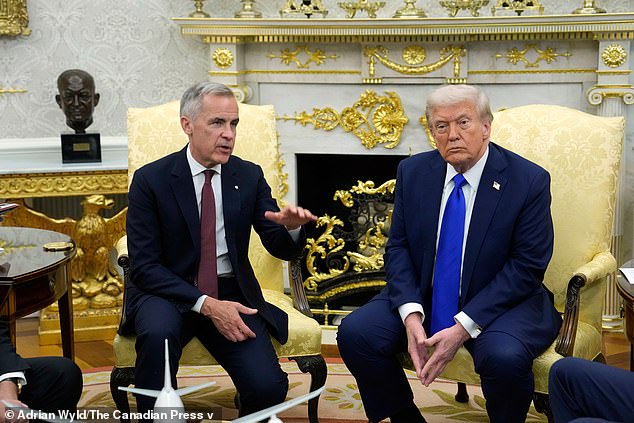
Prime Minister Mark Carney and President Trump at a press conference in 2025.
Initially, these tariffs were scheduled to be implemented at 12:01 a.m. on Wednesday. However, Trump delayed the deadline by three days to facilitate further negotiations, ultimately resulting in a failure to reach an agreement.
Trade disputes have historically been a thorny issue between the two nations, particularly regarding Canadian softwood lumber exports and U.S. access to Canada’s protected dairy market. Despite these tensions, the two countries have maintained a strong alliance, exemplifying their long-standing friendship.
The 5,525-mile U.S.-Canada border remains undefended, with nearly 330,000 individuals and $2 billion worth of goods traversing it daily. Notably, 800,000 Canadians reside in the United States. Trump’s approach marks a dramatic shift from the traditionally friendly relations, characterized by previous cooperation.
The recent tariffs are a part of Trump’s strategy to revive U.S. manufacturing and have been met with significant backlash from the Canadian populace. A petition to expel U.S. Ambassador Pete Hoekstra has gathered nearly 248,000 signatures, accusing him of perpetuating Trump’s contentious rhetoric about annexing Canada.
Last year, U.S. imports accounted for approximately 72 percent of Canada’s goods exports. The potential repercussions of imposing such far-reaching tariffs could be critical ahead of the upcoming midterm elections in November, as they typically impose costs on U.S. importers, who may pass those costs onto consumers.
Editor’s Take
The introduction of heavy tariffs by the U.S. not only strains bilateral relations but also signals a shift in the approach toward international trade. This could lead to increased prices for consumers and a reevaluation of supply chains. As businesses brace for impact, the unfolding situation warrants close monitoring by all stakeholders involved.
Source: www.dailymail.com